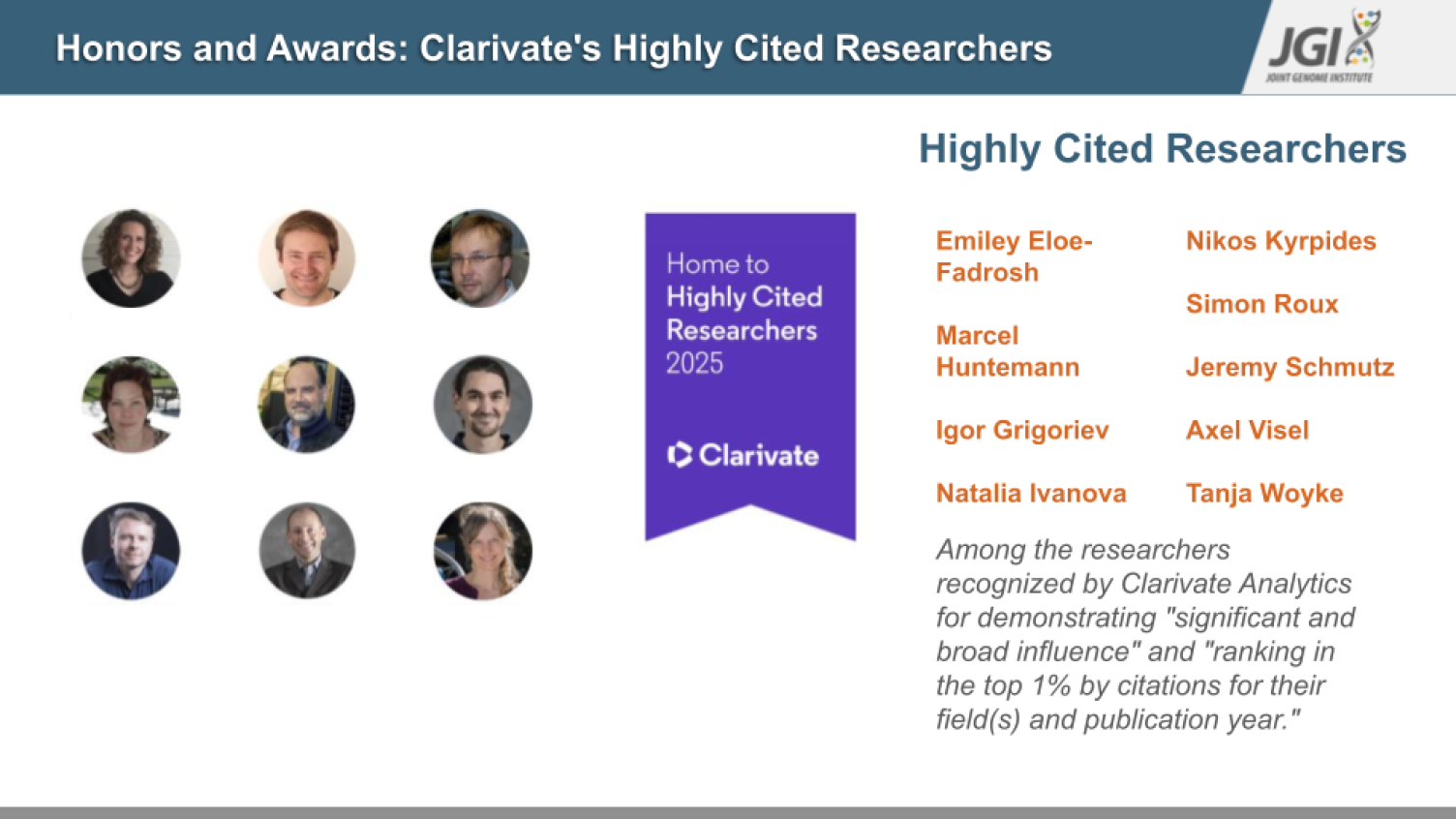
Honors & Awards
- Image

- Image

- Image

- Image

- Image

- Image
Accomplishments at a Glance
Below are briefs on some of the scientific collaborations that came out of the JGI in 2025, as well as highlights around our outreach efforts.








Impact: By the Numbers
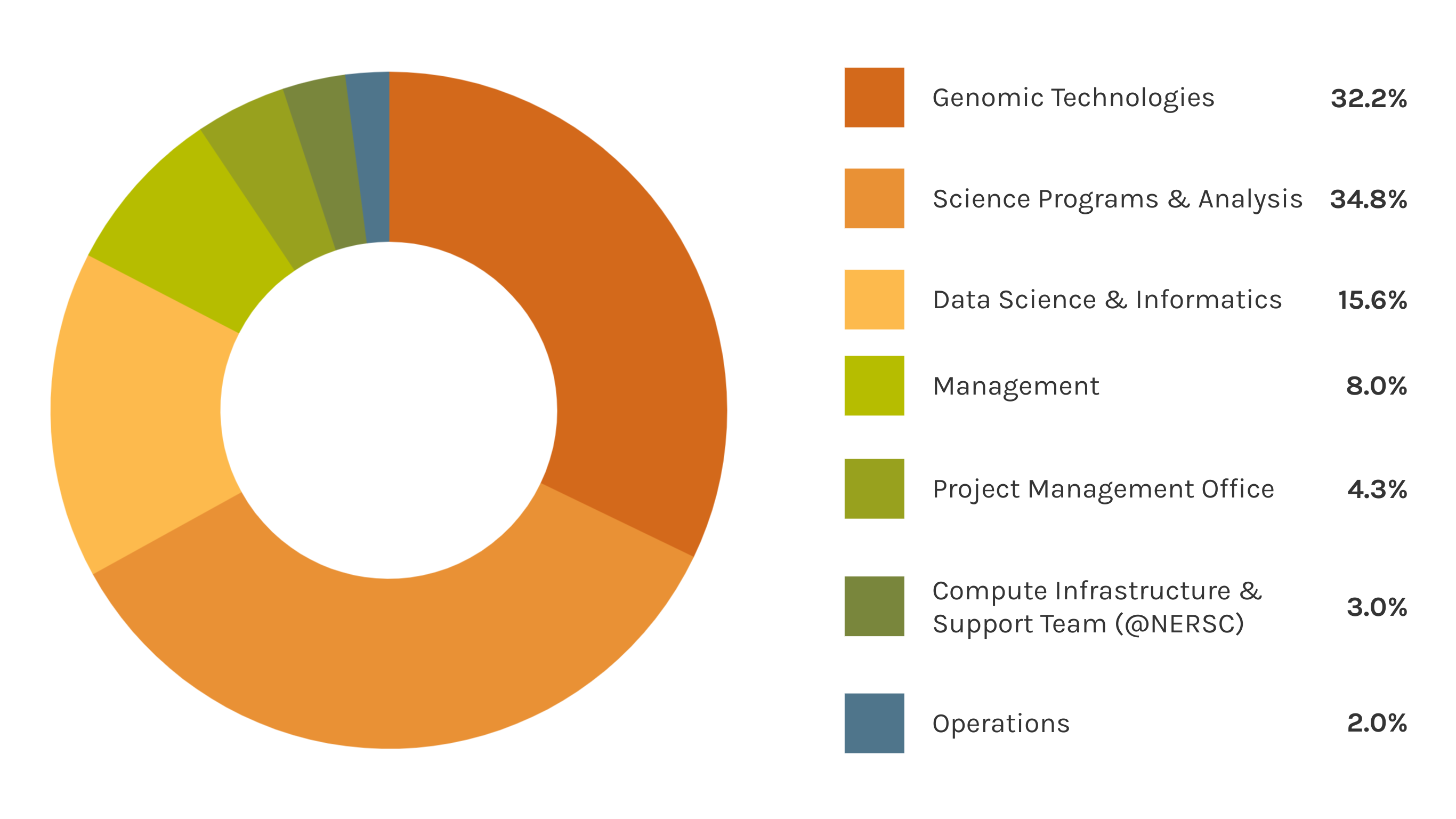
Spending Profile
Users on the Global Map

| Region | Count | Region | Count | Region | Count |
|---|---|---|---|---|---|
| North America | 1,774 | Asia | 113 | Europe | 591 |
| United States | 1,672 | China | 28 | Austria | 19 |
| Canada | 92 | India | 13 | Belgium | 24 |
| Mexico | 9 | Israel | 18 | Croatia | 1 |
| Panama | 1 | Japan | 31 | Czech Republic | 18 |
| Malaysia | 1 | Denmark | 21 | ||
| Australia + New Zealand | 77 | Saudi Arabia | 3 | Estonia | 2 |
| Australia | 60 | Singapore | 5 | Finland | 22 |
| New Zealand | 17 | South Korea | 11 | France | 78 |
| United Arab Emirates | 2 | Germany | 99 | ||
| Africa | 18 | Viet Nam | 1 | Greece | 12 |
| South Africa | 16 | Hungary | 13 | ||
| Tunisia | 1 | South America | 54 | Ireland | 1 |
| Namibia | 1 | Argentina | 1 | Italy | 30 |
| Brazil | 42 | Netherlands | 40 | ||
| Chile | 3 | Norway | 21 | ||
| Colombia | 3 | Poland | 3 | ||
| Ecuador | 1 | Portugal | 8 | ||
| Peru | 3 | Russian Federation | 5 | ||
| Uruguay | 1 | Slovenia | 3 | ||
| Spain | 34 | ||||
| Sweden | 28 | ||||
| Switzerland | 14 | ||||
| Turkey | 1 | ||||
| Ukraine | 1 | ||||
| United Kingdom | 93 |
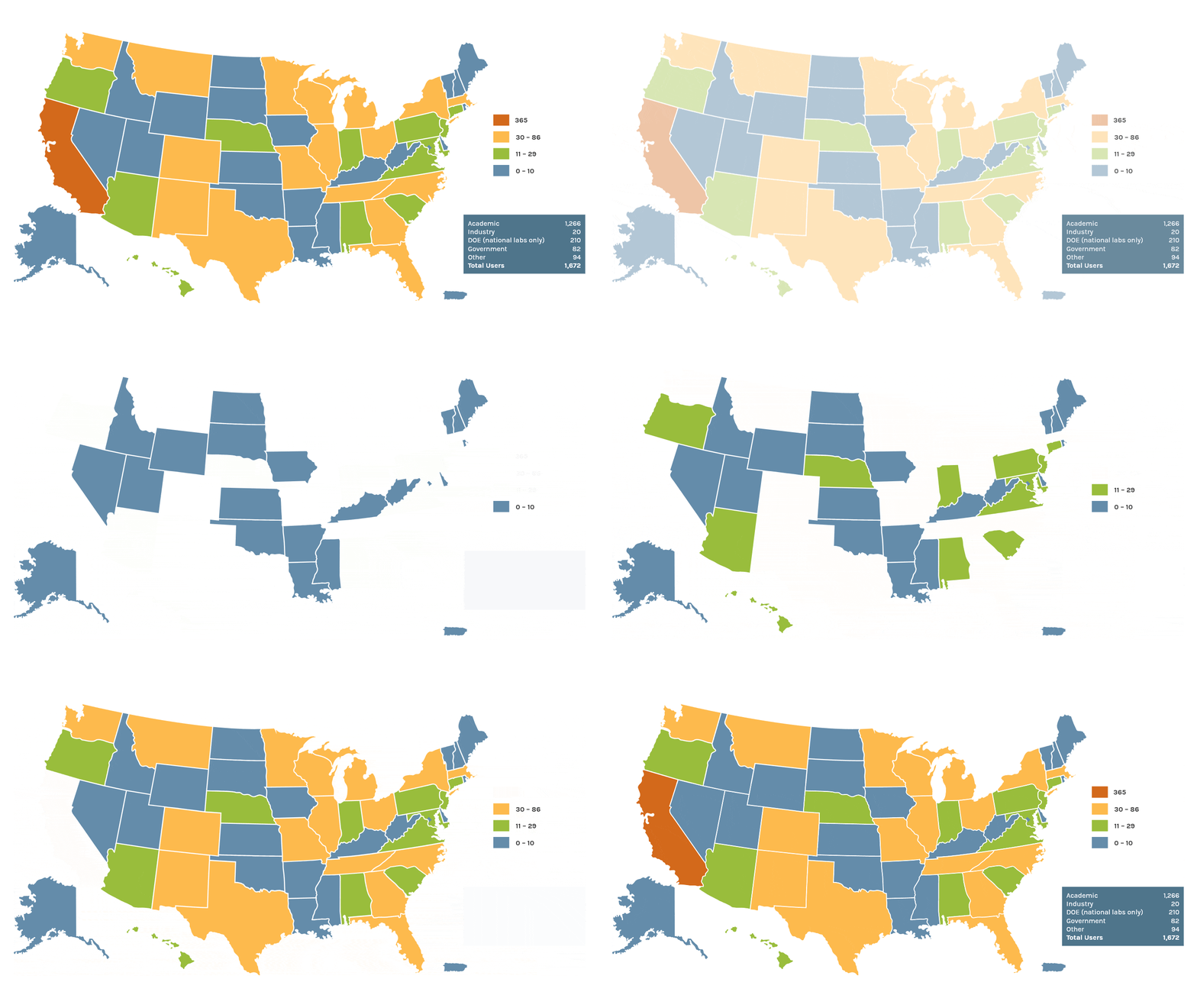
Users on the U.S. Map
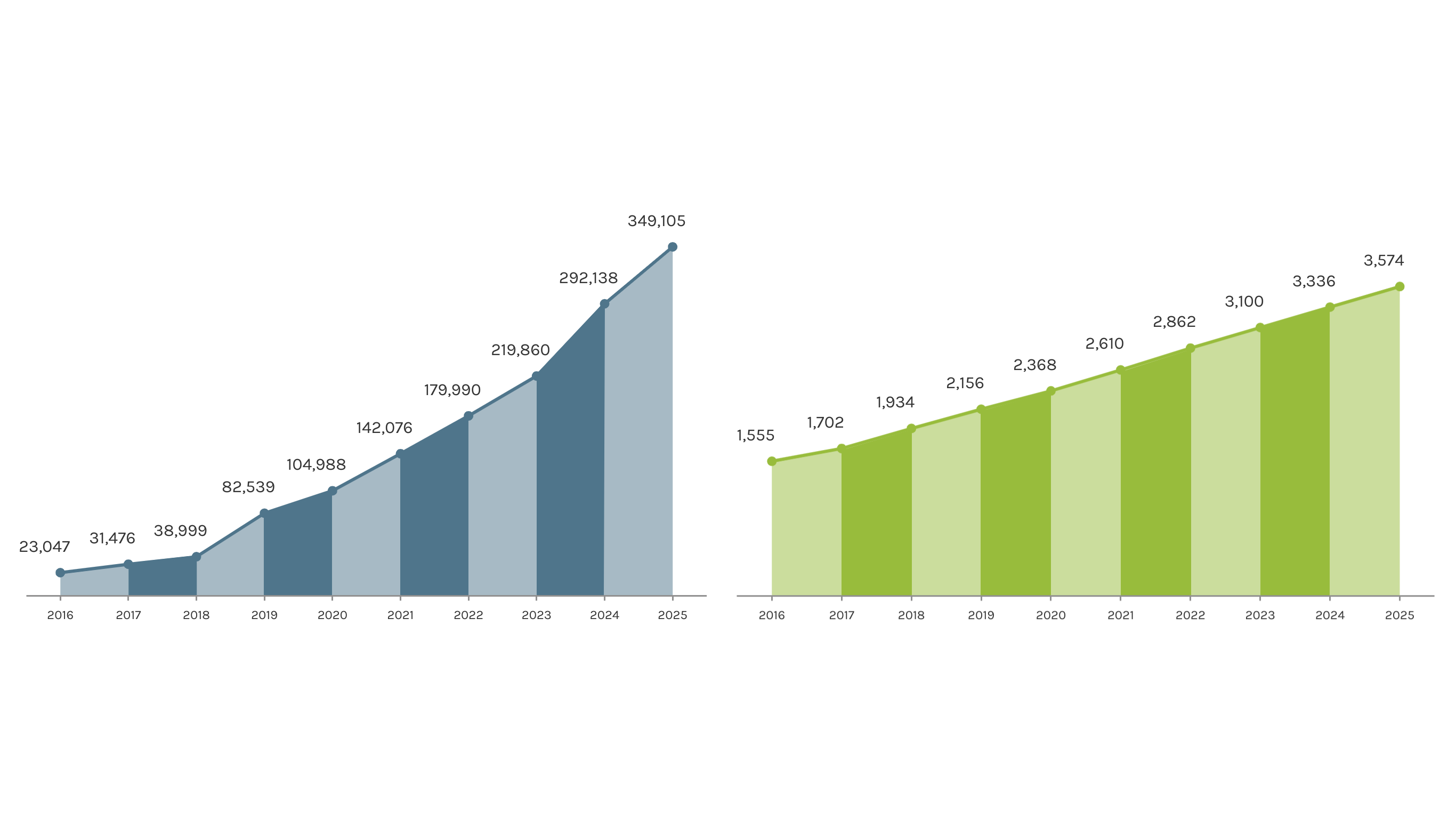
Cumulative Number of Projects Completed & Cumulative Number of Scientific Publications
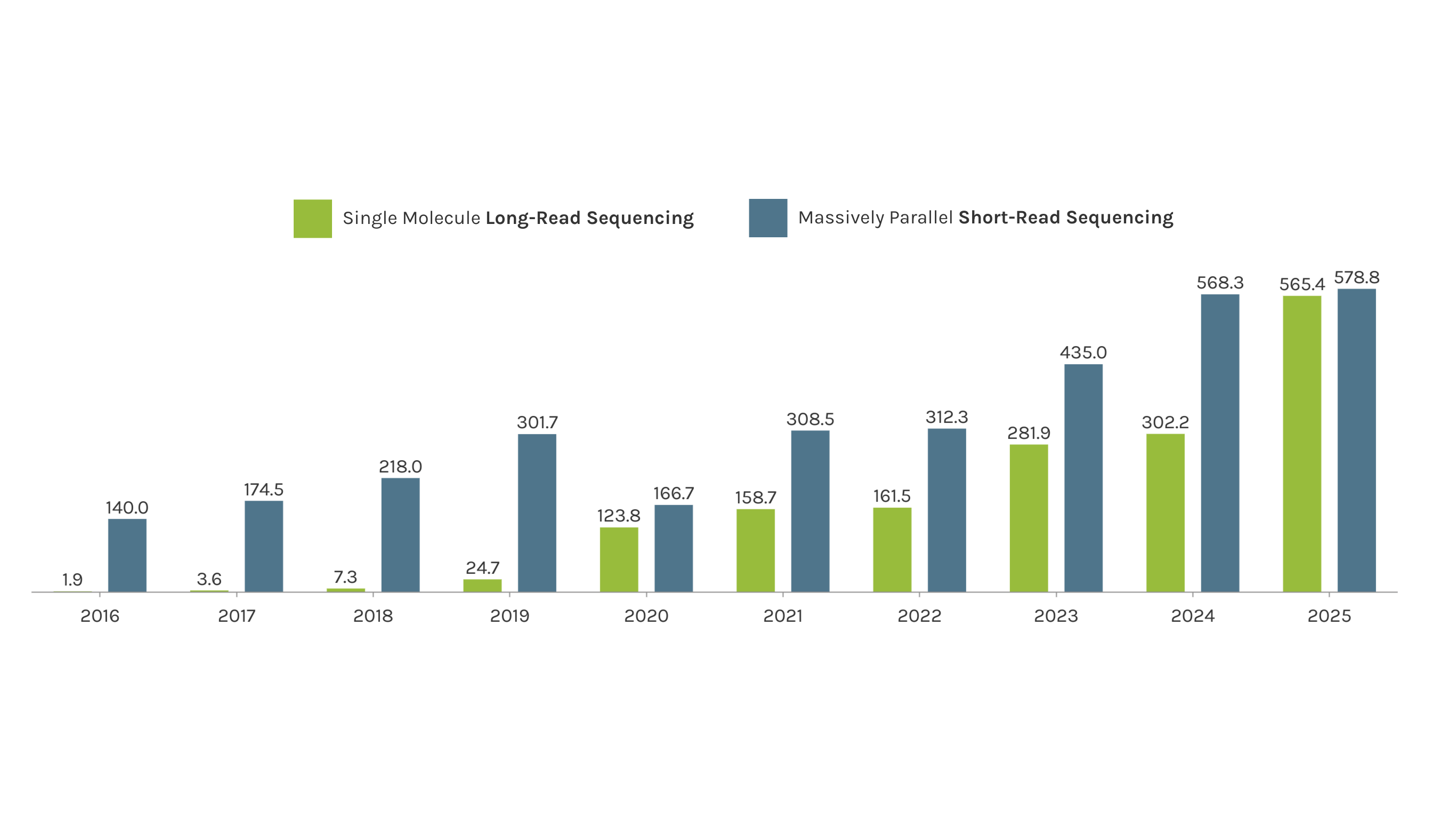
Sequencing Output
(in trillions of bases or Tb)
The JGI supports short- and long-read sequencers, where a read refers to a sequence of DNA bases. Short-read sequencers produce billions of paired-end 150 basepair reads used for genomic minimal draft assembly and resequencing projects, as well as for RNAseq annotation and quantification, such as in gene expression analysis. Long-read sequencers currently average 60,000–70,000 bp reads and are used for high-quality de novo genome assembly and full-length RNAseq transcript sequencing. Combined short-read and long-read totals per year give JGI’s annual sequence output. The total sequence output in 2025 was 1,144.186 Tb.
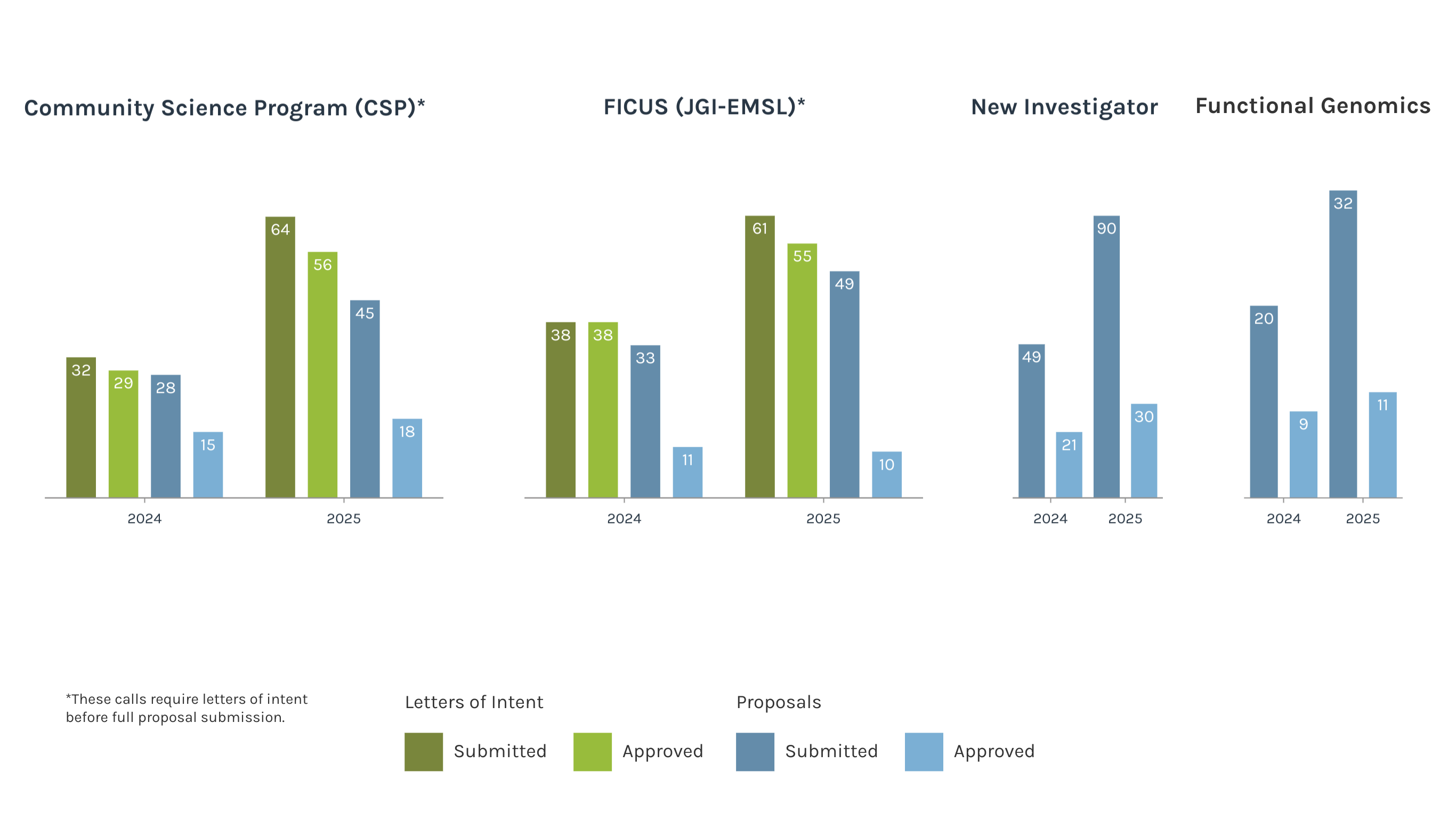
Users Letters of Intent/Proposals Submitted & Approved
Computational Infrastructure: Users of JGI Tools & Data
- JGI Archive and Metadata Organizer (JAMO): 22.438 million file records
- JAMO Archived Data Footprint: 20.288 Petabytes (PB)
- Data Downloads in FY24
- Genome Portal: 6.984 million file-downloads
- Data Portal: 0.517 million file-downloads
- Total: 7.501 million file-downloads
- Data Downloads in FY25
- Genome Portal: 3.534 million file-downloads
- Data Portal: 3.662 million file-downloads
- Total: 7.196 million file-downloads
The Genome Portal provides unified access to all JGI genomic databases and analytical tools. Users can search, download and explore data sets available for all JGI sequencing projects including their status, assemblies, and annotations of sequenced genomes. The Data Portal allows JGI users to more easily access public data sets through a common set of metadata across files submitted by each scientific program. The Genome Portal will be retired once the Data Portal reaches data- and feature-parity with its predecessor. Work remaining to be done includes: limiting payload size for two back-end endpoints, aggregating by IMG taxon OID when ITS IDs are not available, making all data visible to JGI employees, implementing redirects from GP to JDP, and converting User IDs to Contact IDs. We are targeting a January 2026 shutdown.
The JGI manages a bioinformatics cluster, Dori, situated at LBL's LabIT, and highly available web services infrastructure at IGB. The JGI's data management system, JAMO (JGI Archive and Metadata Organizer), operates across data centers — both ingesting new data and delivering data stored at NERSC for processes running at these other centers. The JGI is working on a distributed version of JAMO that can be used by collaborators to manage data from instruments and analyses. JAMO will play a crucial role in ensuring high quality data and files are available through the new BRIDGE: Biological and enviRonmental Infrastructure for Data manaGement and Exploration initiative.
As part of our business continuity planning, JGI has worked with the Environmental Molecular Sciences Laboratory to enable JAMO to automatically transmit and store files on EMSL's HPSS tape system via Globus. Currently, all new raw sequencing data is being transmitted. Over the next year, all legacy data will be restored from NERSC's tape system and transmitted automatically to EMSL.
Photography by Robinson Kuntz/Berkeley Lab. Director’s perspective footage, graphics and photos by: Menaka Wilhelm; Meghan Zodrow/Berkeley Lab; Graham Rutherford; Massie Ballon; OpenAI; Leo Baumgart, Sharon Greenblum and Ronan O’Malley; Bezhad Rad; Wu D, Seshadri R et al. Sci Adv. 2025, CC BY; Allison Joy; Jonelle Basso; Thor Swift/Berkeley Lab; Utumporn Yawichai; Tasha Kostyuk.