New and Improved: Eucalyptus Reference is Now Accessible
An improved genome assembly to support targeted tree breeding for the bioeconomy.
Image
E. grandis is one of 900 eucalyptus species. (Zander Myburg)
The Science
Researchers report a new reference genome for eucalyptus in the July edition of the journal G3 Genes | Genomes | Genetics, with significant advances compared to the 2014 Eucalyptus grandis reference genome that has been widely adopted. The new genome assembly resolves both haplotypes, meaning it separately represents the sets of chromosomes inherited from each parent. It also has 700-fold greater contiguity, meaning the genome is reconstructed in much larger and more complete segments. This allows for more accurate and detailed comparative genomic analyses.
The Impact
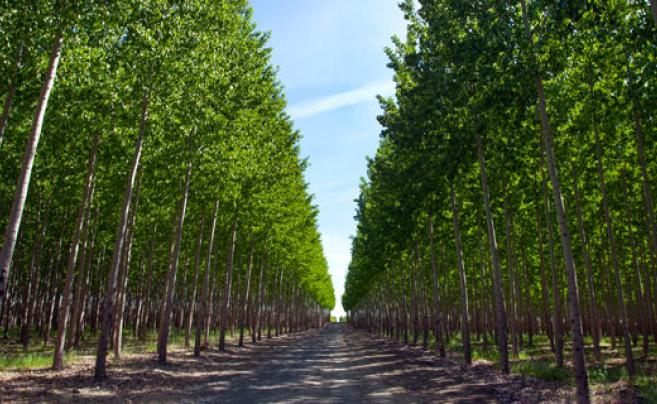
There are 900 species of eucalyptus. The trees are fast-growing plantation crops that supply wood and fiber for various industrial uses ranging from timber to paper, biomaterials and biorefinery products. Given the market demand for eucalyptus in various industries, having genomic resources to develop molecular breeding tools has been critical. The new improved genome assembly generated through the JGI’s Community Science Program will help support targeted genetic breeding of eucalypts as woody biomass crops for the bioeconomy. The work contributes to the efforts of the U.S. Department of Energy (DOE) Office of Science Biological and Environmental Research program to provide the fundamental science to support bioenergy innovations and contribute to the bioeconomy.
Summary
In the past decade, many breeding tools for eucalyptus have relied on the E. grandis reference genome published in 2014 by a team led by University of Pretoria scientists with help from researchers at the DOE Joint Genome Institute (JGI), a DOE Office of Science User Facility located at Lawrence Berkeley National Laboratory.
Now, enabled once again by the JGI’s Community Science Program, University of Pretoria researchers including first author Anneri Lötter, a graduate student in Zander Myburg's lab, aimed to provide an improved eucalyptus genome assembly generated using advanced technologies to reconstruct the complete sequences of individual chromosomes. The team describes the latest eucalyptus reference genome, this time generated using an E. grandis tree that was commercially cultivated for industrial purposes in South Africa. The South African team collected the plant tissues. DNA and RNA sequencing were conducted by the JGI, along with genome assembly and annotation. Genome contiguity of the 2025 phased reference and 2014 diploid genome reference was visualized with GENESPACE, a computational tool for comparative genomics.
Image
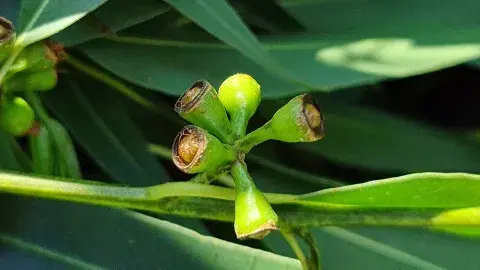
Close-up of eucalyptus buds. (Anneri Lötter and Zander Myburg)
With a more robust reference genome, researchers have unlocked new information on the structural diversity of eucalyptus. The 2014 genome, generated using a Brazilian tree, had a gene annotation completement level of 93.8%. The 2025 assembly has a gene annotation completement level of 99.4%.
In comparing the two assemblies, the researchers also noticed that the 2025 haplotype-phased assemblies are 70–90 Mbp smaller than the 2014 reference, though they have similar numbers of genes. The team hypothesizes the difference might not be due to repeated sequences, but rather the more accurate assembly of regions in the 2025 reference genome.
Early comparative analyses have given the researchers glimpses of the population and pangenome variations in the eucalyptus species. The researchers are already working toward a eucalyptus pangenome to better understand the genetic structural diversity of the genus. Understanding all the gene variants and how they interact with each other could help tree breeders execute more targeted efforts to produce specific lines with desired traits.
The work (proposal: 10.46936/10.25585/60008105, WIP proposal ID: 508017, Myburg, Wegrzyn, Borevitz) conducted by the US Department of Energy Joint Genome Institute (https://ror.org/04xm1d337), a DOE Office of Science User Facility, is supported by the Office of Science of the US Department of Energy operated under contract no. DE-AC02-05CH11231. The bioinformatics work conducted at the University of Pretoria was supported by the University of Connecticut (UConn) Computational Biology Core, who also provided computational biology support.
Our Plant Program focuses on biofuel feedstock species and plant-microbe interactions, advancing efforts to create renewable energy sources and bolster agricultural resilience.
The CSP provides the scientific community at large with access to high-throughput sequencing and other resources at the JGI for projects of relevance to Department of Energy missions.