| Name | Institution | Proposal Title |
|---|---|---|
| Branco, Sara | University of Colorado, Denver | The genetic basis of tolerance to drought across the fungal tree of life |
| Burgos, Asdrubal | University of Guadalajara (Mexico) | Whole genome sequencing of the cactus crop Opuntia ficus-indica and its wild relative Opuntia karwinskiana to unravel the mechanisms that balance productivity and resilience |
| Busby, Posy | Oregon State University | Leaf surface metabolomics in Populus trichocarpa |
| Chen, Hao | Auburn University | Linking lignin engineering to drought stress resilience: RNA-Seq and metabolomic insights in lignin biosynthetic pathway edited Populus |
| Chen, Jay | Oak Ridge National Laboratory | Whole genome sequencing of Populus deltoides natural variants to enable genomic prediction and genome-wide associated studies |
| Coleman, Maureen | University of Chicago | Novel lineages and microbial interactions in deep low-productivity freshwaters of the Great Lakes |
| Cross, Hugh | National Ecological Observatory Network | Continental-scale metagenomics: leveraging the NSF National Ecological Observatory Network to advance understanding of soil and freshwater microbial dynamics |
| Freedman, Zac | University of Wisconsin, Madison | How do viral-microbial interactions shape soil C biogeochemistry in northern temperate forests? |
| Maruyama, Fumito | Hiroshima University (Japan) | Uncovering the roles of uncultivated Patescibacteriota in groundwater biogeochemical cycling through the analysis of symbiotic interactions |
| Jonikas, Martin | Princeton University | Synthesis of essential parts for the functional reconstitution of the algal pyrenoid |
| Lofgren, Lotus A. | Duke University | A genus-wide genomic and transcriptomic catalog for ectomycorrhizal nitrogen metabolism |
| Stadler, Lauren | Rice University | Elucidating determinants of mobile genetic element host range in microbial communities |
| Xiang, Tingting | University of California, Riverside | Unraveling the genomic and regulatory basis of photosynthetic and metabolic adaptation in Symbiodiniaceae dinoflagellates |
| Yau, Sheree | Centre National de la Recherche Scientifique (France) | Connectivity of Arctic microbiomes: from glaciers to fjords |
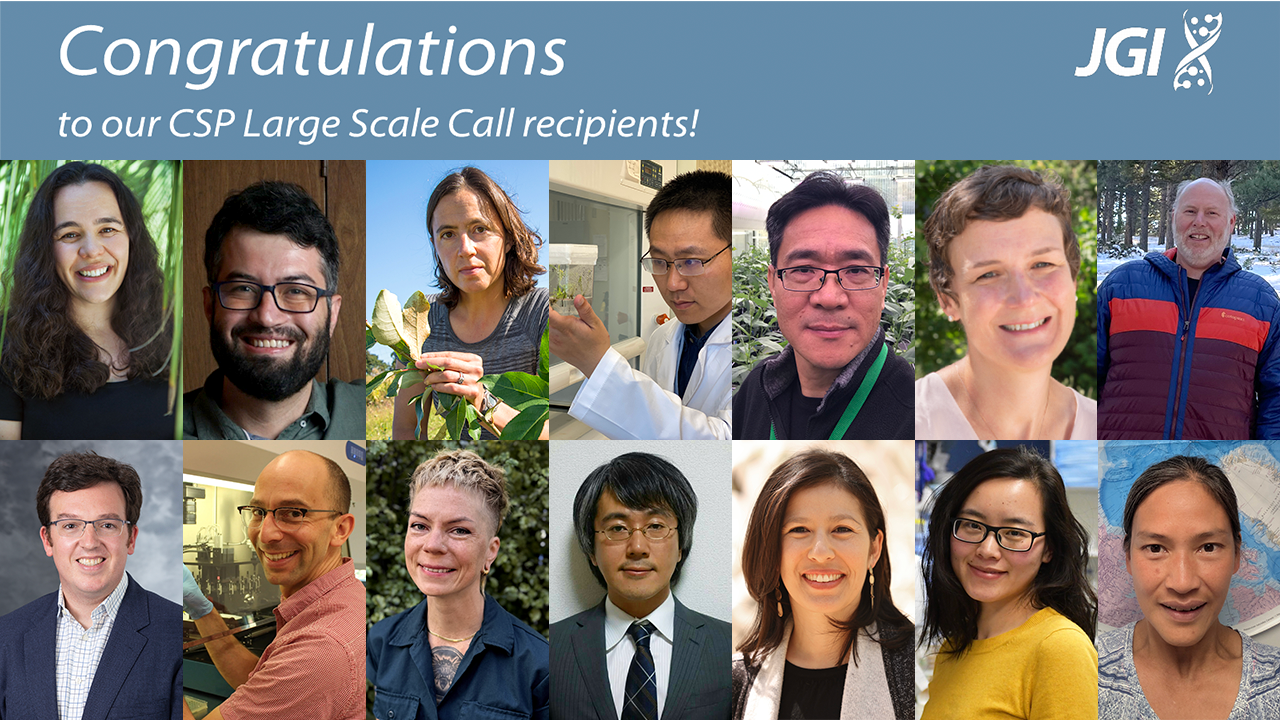 [Pictured from left to right are: [Above] Sara Branco, Asdrubal Burgos, Posy Busby, Hao Chen, Jay Chen, Maureen Coleman and Hugh Cross; [Below] Zac Freedman, Martin Jonikas, Lotus Lofgren, Fumito Maruyama, Lauren Stadler, Tingting Xiang and Sheree Yao. ] ]
The JGI welcomed 14 scientists selected for our 2026 Community Science Program Large Scale call.
This portfolio accelerates bioenergy innovation through genomic discovery across diverse organisms and ecosystems. Scientists are engineering next-generation feedstocks through CRISPR-edited poplars with optimized lignin, engineering heat-resilient algae for industrial applications, and developing RNA barcoding systems to optimize microbial bioreactors. This genomic research creates new opportunities for biomanufacturing, from industrial enzymes discovered in extreme environments to engineered microbiomes that accelerate biomass processing.
This year’s portfolio also includes a project led by the National Ecological Observatory Network (NEON) in collaboration with the National Microbiome Data Collaborative (NMDC) to produce open metagenomics data. Taking the JGI’s call for large-scale projects at their word, the research consortium aims to generate over a terabase of sequence.
“We are thrilled to support this year’s CSP awardees as they embark on ambitious projects that span disciplines and scales,” said Tanja Woyke, the JGI’s User Programs Deputy. “These proposals highlight the creativity of our user community and their commitment to tackling fundamental scientific challenges aligned with DOE’s mission.”
The Community Science Program Large Scale Call is focused on genomic science projects that address biofuel and bioproducts production, leveraging efforts including systems-based approaches to unravel functional capabilities of plants, microbes and microbial communities, and understanding of natural environmental processes — questions relevant to the missions of the DOE’s Office of Biological and Environmental Research (BER) program. The accepted proposals will lead to large-scale AI-ready data to support the global research community.
See below for the full list of 2026 CSP Large Scale Call recipients.
More Details
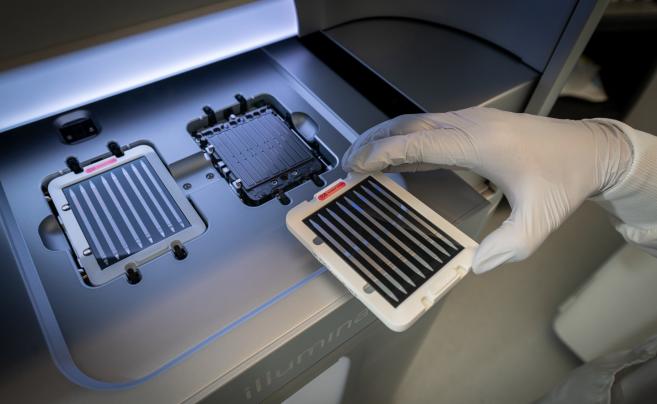
CSP Large Scale Call
The Community Science Program Large Scale Call is focused on genomic science projects that address sustainable biofuel and bioproducts production.

Offerings & Capabilities
With a hands-on approach, we are able to offer our investigators unique strategies suited to a vast array of niche research specialities.
Frequently Asked Questions: Proposal Submission
Find a list of Frequently Asked Questions about our proposal submission process, as well as examples of successful LOIs and submissions.
Science Programs
Prospective users are encouraged to reach out to program heads with questions about the JGI’s science and opportunities to partner with the JGI on their research.