


| Name | Affiliation | Title | Description |
|---|---|---|---|
| Aron, Allegra | University of Denver | Exploring lanthanide homeostasis mechanisms across methylobacteria | This project seeks to understand the molecular mechanisms for the uptake and transport of lanthanide metals in Methylobacterium, environmental bacteria that metabolize methanol. The research team aims to determine the chemistry of hand-off mechanisms between extracellular scavengers and intracellular proteins. This could enable new strategies for separations of critical materials. |
| Pilatova, Jana | Lawrence Berkeley National Laboratory | Storage, metabolism, and microbial vision: Molecular mechanisms of nitrogen-rich biocrystallization | Microscopic crystals observed in microbes for centuries have recently revealed their secrets. Emerging research suggests they play vital roles in nutrient storage, light sensing, and stress resilience. Unraveling their formation and function offers new insights into microbial life and its impact on our planet. |
| Orphan, Victoria | California Institute of Technology | Developing targeted, spatially resolved multiomic analysis of environmental methane-oxidizing syntrophic consortia and their associated viruses | The Orphan lab is investigating the metabolic interactions between structured syntrophic methane-oxidizing archaea and sulfate-reducing bacterial consortia from anoxic methane-rich environments. Using phylogenetically resolved imaging and laser capture of differently structured consortia coupled with sequencing, proteomics, and metabolomics, researchers will investigate the spatial distribution of key proteins and metabolites within and between different consortia partners to expand our understanding of this methane-fueled microbial symbiosis. |
| Shabtai, Itamar | Connecticut Agricultural Experiment Station | What goes around comes around: Exploring the cyclical nature of soil biogeochemical hotspots | In this project, researchers aim to understand the complex and interacting processes that emerge during root growth, death, and decomposition. They will holistically study how the root’s life cycle shapes the physical structure, chemical composition, and microbial communities of the soil. |
| Vander Yacht, Andrew | Research Foundation of The State University of New York | Investigating the fire-mediated belowground drivers of stress resilience in eastern U.S. forests | Widespread fire suppression in the eastern United States may be preferentially promoting the dominance of fire-sensitive and drought-intolerant trees by altering soil microbial communities. Using field and greenhouse experiments, researchers will determine the extent of such effects and how fire can be used to improve forest resilience to future stressors. |
| Ziels, Ryan | The University of British Columbia | Modeling microbial community metabolism driving bio-electrochemical upgrading of biogas into renewable natural gas | Anaerobic digestion (AD) converts organic waste into renewable biofuel as biogas and is therefore a critical component of the circular bioeconomy. This project aims to combine multiomic measurements with bioprocess modeling to improve the efficiency of a new microbial biotechnology that converts carbon dioxide from AD biogas into clean biofuel. |
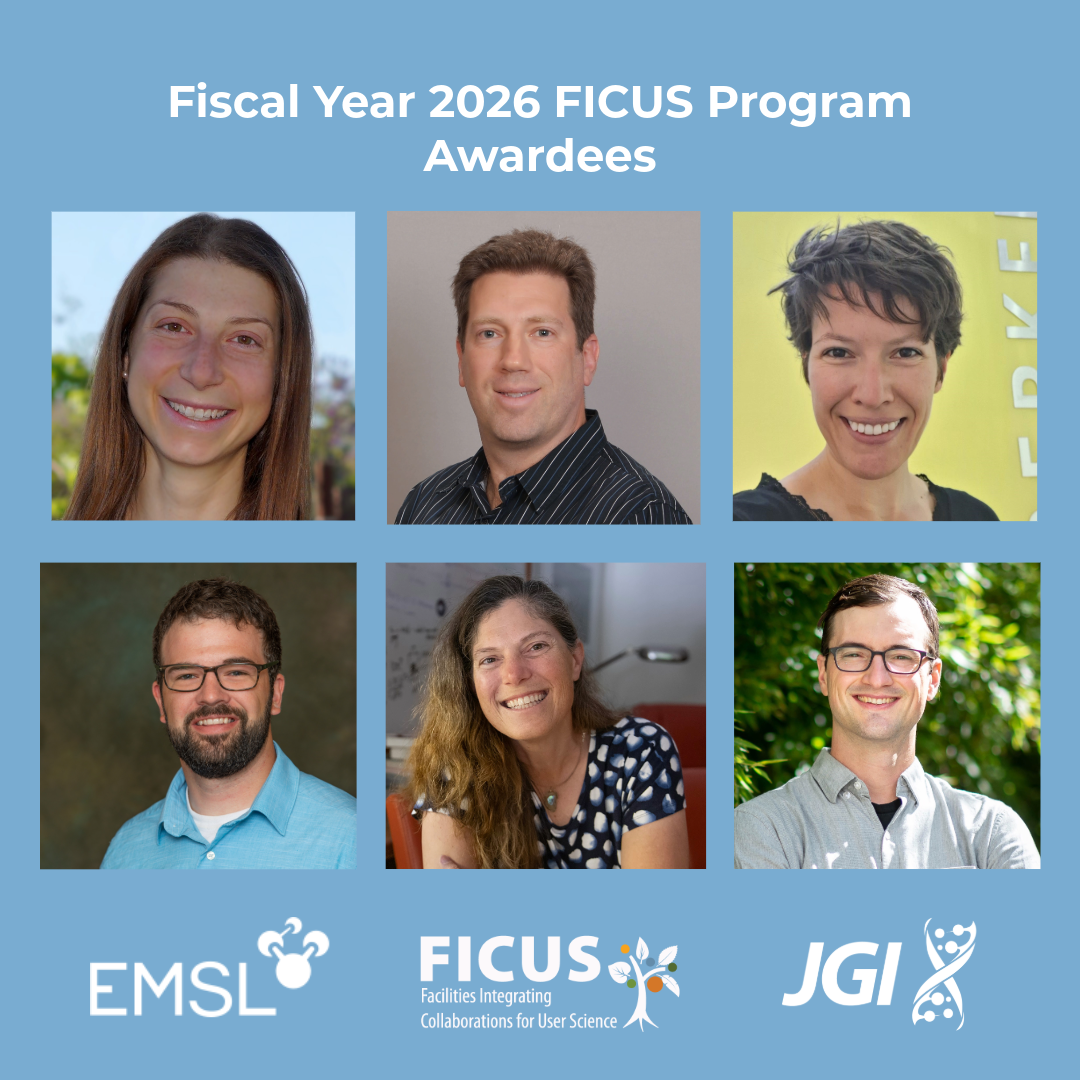
The JGI is excited to welcome six to the Facilities Integrating Collaborations for User Facilities (FICUS) program for fiscal year 2026, in partnership with the Environmental Molecular Sciences Laboratory (EMSL) and other national user facilities. Focus areas for these projects include biofuels, biomaterials and bioproducts; hydrobiogeochemistry; interorganismal interactions; and novel applications of molecular techniques.
The FICUS program is designed to encourage and enable researchers to more easily integrate the expertise and capabilities of multiple Department of Energy Office of Science National User Facilities into their research. Applicants can also request access to the Bio-SANS beamline at Oak Ridge National Laboratory, the Advanced Photon Source at Argonne National Laboratory, and the National Ecological Observatory Network (NEON) through the National Science Foundation (NSF). In recognition of the increasingly collaborative and multidisciplinary nature of DOE mission science projects, this proposal call aims to encourage innovative research exploiting a diversity of capabilities to generate datasets beyond what each facility could generate individually.
Learn more about the projects below.
More Details
FICUS
The FICUS call targets high-risk/high-payoff proposals, providing access to the capabilities and expertise of multiple DOE National User Facilities in one research proposal.

Offerings & Capabilities
With a hands-on approach, we are able to offer our investigators unique strategies suited to a vast array of niche research specialities.
Science Programs
Prospective users are encouraged to reach out to program heads with questions about the JGI’s science and opportunities to partner with the JGI on their research.

User Programs
Learn more about calls available through our Community Science Program, as well as collaborative calls with our partner facilities and other opportunities.

