| Name | Affiliation | Proposal Title | Description |
|---|---|---|---|
| Chen, Hao | Auburn University | Unraveling the crosstalk in poplar's transcriptional regulatory network for drought tolerance and wood formation using DAP-seq technology | This research maps how genes control drought tolerance and wood production in poplar trees, a key bioenergy crop. By understanding the genetic switches (transcription factors) that regulate these traits, scientists can develop poplars that survive drought while maintaining high biomass production. This directly supports BER's mission to create resilient bioenergy feedstocks through genome-level plant engineering. |
| Cope-Arguello, Matthew | University of California, Davis | Unraveling the gene regulation necessary for bacterial survival using DAP-seq and RNA-seq | This project investigates how bacteria survive starvation by controlling their genes during nutrient-poor conditions. Understanding these survival mechanisms will enable scientists to engineer resilient microbes that persist in soil between crop plantings, supporting bioenergy feedstock growth. The research also reveals how bacteria drive nutrient cycling at low metabolic rates. This advances BER's mission to manipulate microbiomes for improved bioenergy crop production and understanding of environmental nutrient processes. |
| Isimikalu, Theophilus Olufemi | University of Maryland Eastern Shore | Elucidating soil carbon stabilization in switchgrass cutting systems: Influence of root exudation and microbial fingerprints | This project examines how switchgrass root compounds and soil microbes interact under different mowing schedules to optimize biofuel yields. By understanding these plant-microbe relationships and their effects on soil processes, scientists can reduce production inputs while maximizing biomass production. This advances BER's mission to develop bioenergy feedstocks through improved understanding of plant-microbe interactions and how management practices influence nutrient cycles in terrestrial ecosystems. |
| Oakley, Todd H. | University of California, Santa Barbara | Exploring the evolutionary trade-offs of cyanobacterial rhodopsins for broad-spectrum energy capture | Scientists will test millions of rhodopsin protein variants from cyanobacteria to understand how they capture energy from different colors of light. Using machine learning to predict protein function from gene sequences, researchers can design microbes optimized for specific light wavelengths for bioenergy applications. This advances BER's mission to understand microbial metabolism for bioenergy development and build predictive models of biological systems, enabling engineered organisms for enhanced energy production. |
| Philmus, BJ | Oregon State University | Cyanobacterial secondary metabolites: Linking biosynthetic gene clusters to secondary metabolite structures and function | This research identifies compounds produced by cyanobacteria gene clusters to understand their role in freshwater ecosystem interactions. By linking genes to the chemicals they produce, scientists can determine how these compounds affect community dynamics—whether inhibiting competitors, preventing predation, or controlling fungal growth. This advances BER's mission to understand microbe-microbe interactions in freshwater systems and develop predictive models of microbial behavior in terrestrial-aquatic interfaces. |
| Rashotte, Aaron M. | Auburn University | Deciphering cytokinin signaling cascades to prolong photosynthesis and boost yield | This project investigates how the plant hormone cytokinin delays leaf aging, maintaining photosynthesis longer for increased biomass production. Using machine learning to analyze gene expression data, researchers identify key genetic regulators controlling leaf lifespan. DNA synthesis enables testing these genes to develop bioenergy crops with extended photosynthetic capacity. This advances BER's mission to understand plant metabolism at the genome level for improved bioenergy feedstock development. |
| Scesa, Paul | University of South Florida | Animal genomes as a source of hydrocarbon feed stocks and biocatalysts | This project uses soft coral genes as blueprints to produce advanced biofuels and biomaterials. By understanding how corals synthesize defensive compounds, researchers can engineer microbes to manufacture these molecules for energy applications. Gene synthesis enables rapid testing of coral genetic pathways in laboratory systems. This advances BER's mission by developing new biological routes to produce fuels and materials. |
| Scott, Kathleen | University of South Florida | Functional expression of carbonic anhydrases that play key roles in cellular metabolism and the global carbon cycle | This project studies carbonic anhydrase enzymes that convert CO2 to bicarbonate, a critical process in all life forms. By synthesizing 50 genes encoding two understudied enzyme types common in industrial microbes, scientists can understand factors controlling their activity. This advances BER's mission by revealing microbial metabolism mechanisms essential for engineering organisms to produce biofuels and bioproducts, while improving understanding of how microbes drive nutrient cycles. |
| Taylor, Tiffany | University of Bath (UK) | Characterising the transcriptional regulon of plant growth promoting bacterium Pseudomonas fluorescens (SWB25) related to environmental persistence and flexibility to inform sustainable use in agriculture | This project investigates how Pseudomonas fluorescens, a beneficial soil bacterium, regulates genes to survive environmental changes while supporting plant growth. By studying proteins controlling gene expression, plasmids, and dormant gene activation, scientists can engineer more resilient microbes for agriculture. This advances BER's mission to understand and manipulate microbiomes to enhance bioenergy crop productivity through improved nutrient availability and pathogen suppression. |
| Wakao, Setsuko | Lawrence Berkeley National Laboratory | Mapping the transcriptional regulators of silica biomineralization in diatoms | Diatoms produce intricate glass-like cell walls that could inspire new biomaterials. This project identifies genes and regulatory proteins controlling silica formation in these microscopic algae. Using DNA synthesis and sequencing, researchers will map how diatoms regulate biomineralization processes. This advances BER's mission to understand biological systems for biomaterial production, with findings applicable to engineering organisms that produce critical minerals and materials for energy applications. |
| Woolston, Benjamin | Northeastern University | Expanding the product range of anaerobic methanol fermentation | This project will engineer Eubacterium limosum bacteria to transform methanol into valuable chemicals like succinate and isobutanol — key ingredients for fuels and industrial products. By testing multiple genetic pathway variations, researchers aim to create the first anaerobic system for this conversion. This advances BER's mission to develop microbial metabolism for converting feedstocks into biofuels and bioproducts, establishing a new platform for energy-efficient chemical production. |
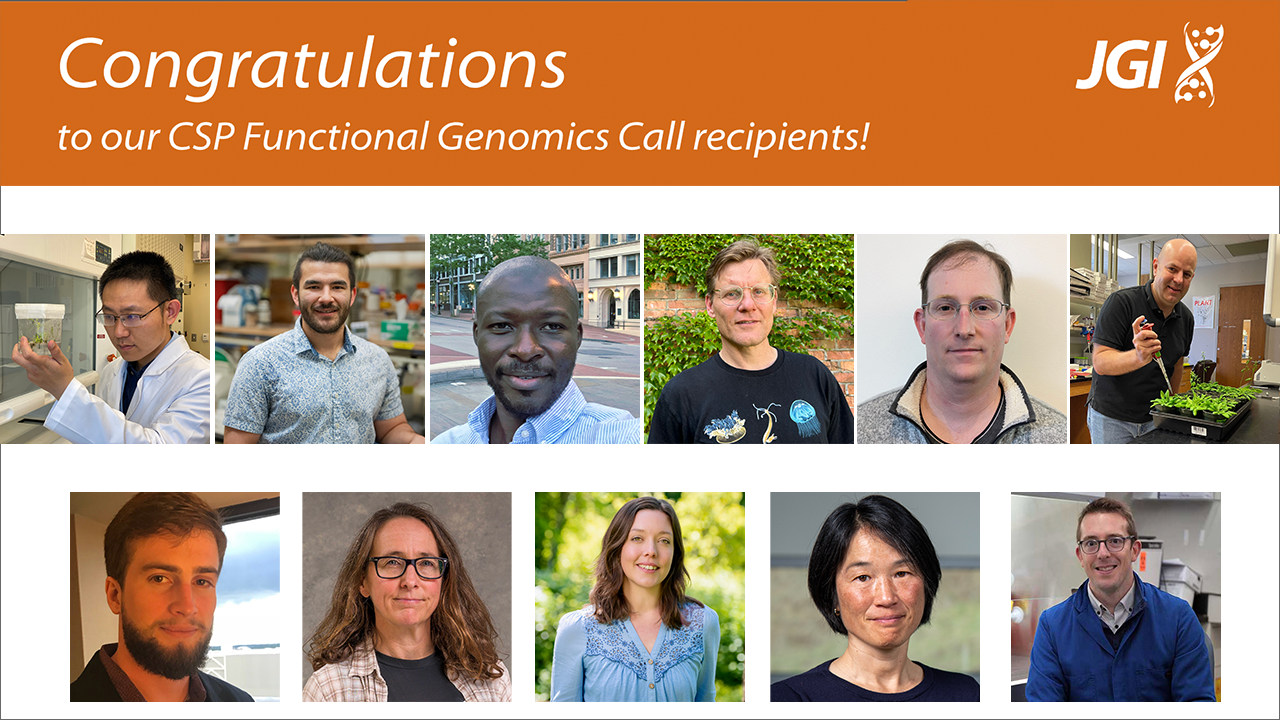 [Pictured from left: [Above] Hao Chen, Matthew Cope-Arguello, Theophilus Olufemi Isimikalu, Todd H. Oakley, BJ Philmus and Aaron M. Roshotte; [Below] Paul Scesa, Kathleen Scott, Tiffany Taylor, Setsuko Wakao and Benjamin Woolston.]
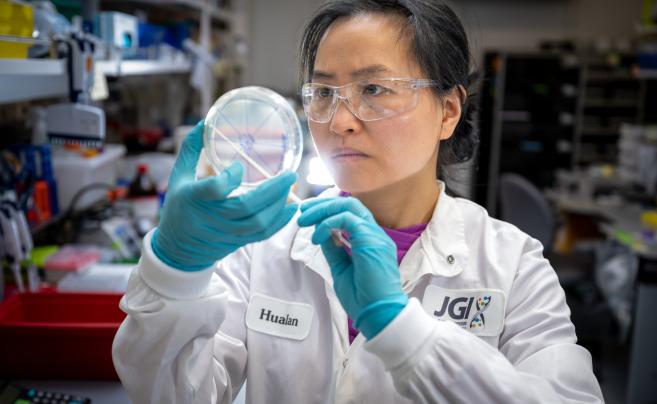
Each year, the JGI accepts proposals for state-of-the-art functional genomics research from scientists who translate genomic information into biological function. Through our CSP Functional Genomics call, we look for projects that will leverage the JGI's DNA synthesis and omics capabilities to enhance understanding of gene and genome function. Tapping into these functions allows researchers to use them for engineering applications in support of advancing the bioeconomy.
This year's project goals range from engineering drought-tolerant woody bioenergy crops through transcriptional network mapping, developing microbial systems to convert renewable feedstocks into advanced biofuels and chemicals, and harnessing biomineralization processes for next-generation materials production. Enabled by the JGI, which is supported by the Department of Energy's Biological and Environmental Research (BER) program, these projects integrate cutting-edge genomic data with predictive modeling and bioengineering to advance U.S. energy independence and biotechnology innovation.
Below find a list of the 11 researchers accepted for 2025. Proposals are accepted year-round; the next deadline is Jan. 29, 2026.
More Details
CSP Functional Genomics
The CSP Functional Genomics call is to enable users to perform state-of-the-art functional genomics research and to help them translate genomic information into biological function.

Offerings & Capabilities
With a hands-on approach, we are able to offer our investigators unique strategies suited to a vast array of niche research specialities.
Frequently Asked Questions: Proposal Submission
Find a list of Frequently Asked Questions about our proposal submission process, as well as examples of successful LOIs and submissions.
Science Programs
Prospective users are encouraged to reach out to program heads with questions about the JGI’s science and opportunities to partner with the JGI on their research.