PI Name | Affiliation | Proposal Title |
|---|---|---|
| Alzubaidy, Hanin | GEOMAR Helmholtz Centre for Ocean Research Kiel | Functional genomics of microbiome-enabled suppression of Phytophthora infection in Zostera marina |
| Covert, Markus | Stanford University | E. coli Odyssey: Characterizing microbial behavior across a range of environments to predict and discover unknown gene function |
| Dodani, Sheel C. | University of Texas, Dallas | Machine learning-guided discovery of microbial enzymes for carbon-fluorine bond chemistry |
| Fixen, Kathryn | University of Minnesota | Using a bacterial chassis for high throughput identification of ferredoxins that support nitrogen fixation |
| Fudyma, Jane | University of Arizona | Integrating soil VOC fluxes and metatranscriptomics to define microbial functional traits across plant-driven nutrient and moisture gradients in arid soils |
| Gregoire, Daniel S. | Carleton University | Breathing new life into rare earth element metabolism |
| Guerrero, Andreas | Oregon State University | Characterizing functional effects and genomic basis of secondary metabolism in Mucoromycota spore germlings |
| Hulin, Michelle | Michigan State University | Characterizing prophage-encoded transcription factors in Pseudomonas |
| Kunjapur, Aditya | University of Delaware | Engineering thermostability of aldehyde and amine modifying enzymes for orthogonality in lysates of mesophiles |
| Lee, Seung Hwan (Allen) | University of Minnesota | Thiolase-based C-C elongation pathways for biomanufacturing |
| Li, Han | University of California, Irvine | High-throughput elucidation and enhancement of latent biomimetic cofactor utilization by enzymes |
| Miller, Anne‑Frances | University of Kentucky | Electron transfer flavoproteins from diverse environments and metabolic niches, filling data gaps to enable a phylogenetic tree |
| Peng, Xuefeng (Nick) | University of South Carolina | Multi-omics characterization of fungal GH7 cellulases for sustainable bioconversion processes |
| Schmid, Amy K. | Duke University | Massively parallel characterization of archaeal gene networks to transform the bioeconomy |
| Singh, Ritu | University of California, Davis | Decoding the regulatory logic of host generalism: A DAP-seq cistrome map of transcriptional plasticity regulators in Botrytis cinerea |
| Tan, Jiaqi | Louisiana State University | Functional transcriptomics of plant-microbe interactions |
| Willing, Claire | University of Washington | Fire-adapted ectomycorrhizal fungi: Genomic mechanisms of heat germination and nutrient mobilization in Rhizopogon olivaceotinctus |
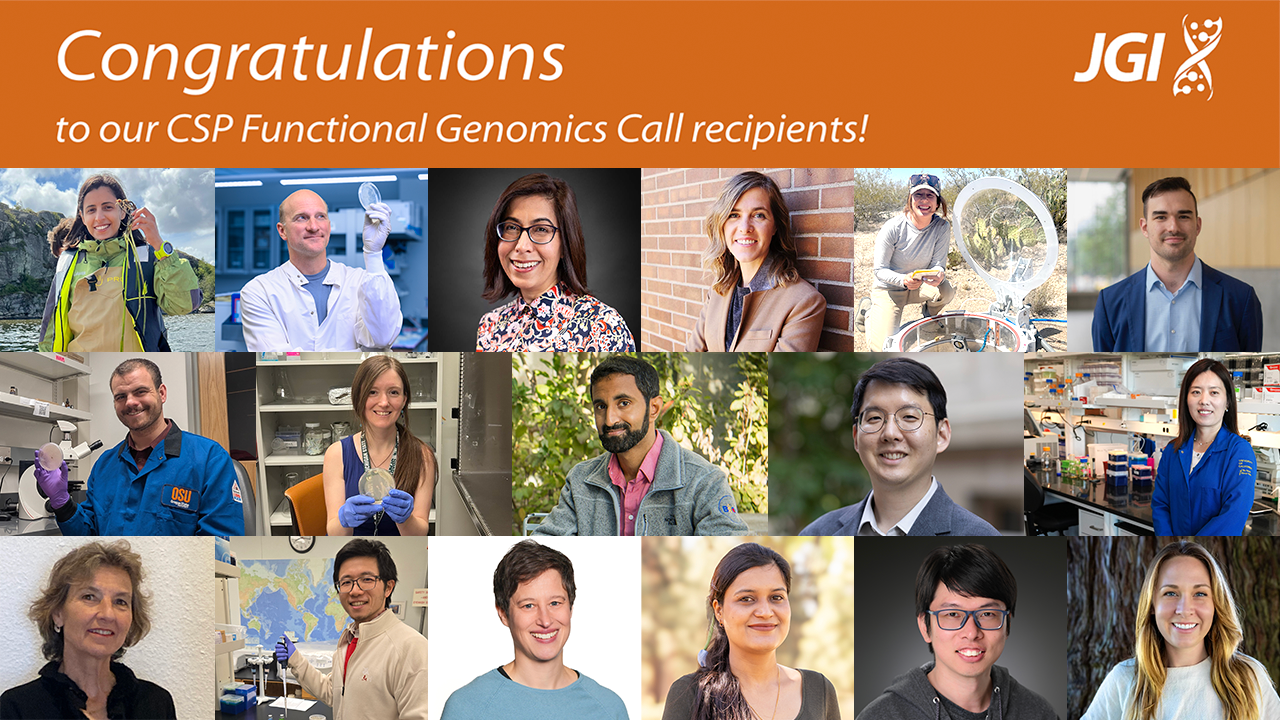
Pictured from left: [Above] Hanin Alzubaidy, Markus Covert, Sheel C. Dodani, Kathryn Fixen, Jane Fudyma, Daniel S. Gregoire; [Middle] Andreas Guerrero, Michelle Hulin, Aditya Kunjapur, Seung Hwan (Allen) Lee, Han Li; [Below] Anne-Frances Miller, Xuefeng (NIck) Peng, Amy K. Schmid, Ritu Singh, Jiaqi Tan, Claire Willing
Each year, the Joint Genome Institute (JGI) accepts proposals for state-of-the-art functional genomics research from scientists who translate genomic information into biological function. Through our CSP Functional Genomics call, we look for projects that will leverage the JGI's biodesign and omics capabilities to enhance understanding of gene and genome function. Understanding these functions gives researchers the tools to build engineering applications in support of advancing the bioeconomy.
This year's projects span diverse areas of biological research to develop applications ranging from engineering microbial enzymes that unlock novel biochemical pathways, to exploring how microbes metabolize and mobilize rare earth elements and other high-value resources. Enabled by the capabilities and expertise within the JGI, these projects integrate genomic data with cutting edge experimental techniques for predictive modeling and bioengineering applications to advance U.S. energy independence and secure domestic supplies of materials essential to a growing bioeconomy. The JGI is a DOE Office of Science national scientific user facility supported by the Biological and Environmental Research (BER) program.
Below find a list of the 17 researchers accepted for 2026. Proposals are accepted year-round; the next deadline is Jan. 29, 2027.
More Details