| Proposer Name | Proposer Affiliation | Proposal Title |
|---|---|---|
| Chakraborty, Romy | Lawrence Berkeley National Laboratory | Phyto-Microbial Critical Mineral Recovery: Moving from Isolate Genomic Potential to Rhizosphere Transcriptomic Realization |
| Chiniquy, Dawn | Lawrence Berkeley National Laboratory | Quantifying Bacterial Rare-Earth Uptake To Enable Bio-Based Critical-Mineral Capture |
| Glaesener, Anne | University of California, Berkeley | Exploring the Mechanisms of Copper Homeostasis in Acidophilic Algae |
| Hallam, Steven | University of British Columbia (Canada) | Mechanistic Basis for Metallo–Biological Surface Interactions within Engineered Living Materials |
| Hanikenne, Marc | University of Liege (Belgium) | Genomic and Metabolic Basis of Divergent Zinc Hyperaccumulation Strategies in Arabidopsis halleri |
| Kerfeld, Cheryl | Michigan State University | Bacterial Microcompartment-based Biomaterials for Capture of CMMs and REEs |
| Marlow, Jeffrey | Boston University | Bioleaching of Critical Minerals from High Economic Interest Ore Sources by a Halophilic Consortia |
| Martinez-Gomez, N. Cecilia | University of California, Berkeley | Decoding Biogenic REE Mineralization in M. extorquens AM1 for Scalable Critical Metal Recovery |
| Merchant, Sabeeha | University of California, Berkeley | Structural and Functional Properties of a Potential Cell Surface Metal-Binding Protein in the Green Alga Auxenochlorella UTEX 250-A |
| Nuzhdin, Sergey | University of Southern California | Mechanisms of Selective Rare Earth Element Recovery in Giant Kelp |
| Porter, Stephanie | Washington State University | Investigating Evolutionary Solutions to Nickel Transport and Accumulation in Serpentine Plant-Microbial Symbionts |
| Remacle, Claire | University of Liege (Belgium) | New Insights Into Plastocyanin Maturation |
| Rinke, Christian | University of Innsbruck (Austria) | Harnessing the Landfill Microbiome: Multi-Omics Detection and Nanoscale Exploration of Bioleaching targeting Rare Earth Elements |
| Sedbrook, John | Illinois State University | Accelerating Discovery of Mechanisms Underlying Nickel Biorecovery Across Brassicaceae Species |
| Steck, Viktoria | GEOMAR Helmholtz Centre for Ocean Research (Germany) | New Biological Controls on the Critical Mineral Manganese Through Marine Microbial Phosphorus Metabolism |
| Sun, Ning | Lawrence Berkeley National Laboratory | Mapping A Microbial System for Heavy Rare Earth Elements Recovery |
| Vatamaniuk, Olena | Cornell University | Nanoscale Control of Copper Uptake, Transport, and Sequestration in Plants for Phytomining Applications |
| Wakao, Setsuko | Lawrence Berkeley National Laboratory | Toward Mechanistic Understanding of Rare Earth Elements and Critical Minerals Absorption: Exploring the Genetic Basis of Algal Response to Critical Minerals |
| Wang, Meng | University of Houston | Developing a Cell-Based Fitness Assay for High-Throughput Assessment of Ferritin Metal-Selectivity and Engineering |
| Werner, Allison | National Laboratory of the Rockies | Microbial REE Atlas: Discovery, Validation, and Functional Elucidation of Rare-Earth Element (REE) Binding Proteins Towards Critical Mineral Recovery |
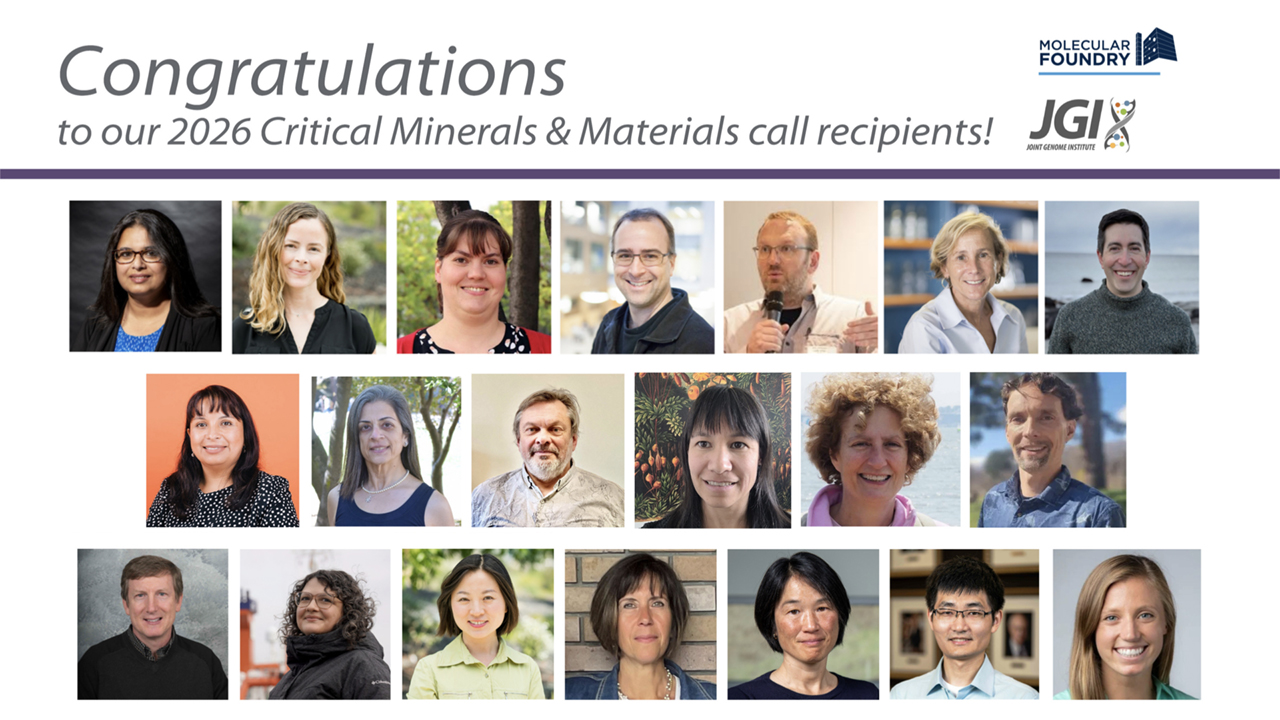
Pictured from left: [Top row]: Romy Chakraborty, Dawn Chiniquy, Anne Glaesener, Steven Hallam, Marc Hanikenne, Cheryl Kerfeld, Jeffrey Marlow;
[Row 2]: N. Cecilia Martinez-Gomez, Sabeeha Merchant, Sergey Nuzhdin, Stephanie Porter, Claire Remacle, Christian Rinke;
[Bottom row]: John Sedbrook, Viktoria Steck, Ning Sun, Olena Vatamaniuk, Setsuko Wakao, Meng Wang, and Allison Werner.
A total of 20 proposals were selected by the Joint Genome Institute (JGI) and the Molecular Foundry (TMF) for their collaborative user program. The portfolio of research proposals integrates genomics with nanoscale science, all aimed at accelerating discoveries and developing transformative bio-based technologies involving critical minerals and materials.
The Joint Genome Institute and Molecular Foundry are DOE Office of Science user facilities. They provide researchers leading approved proposals with free access to their resources and capabilities to advance their DOE mission-relevant science.
Supported by the Biological and Environmental Research (BER) program, the JGI provides advanced genomic capabilities and access to large-scale data resources. Supported by the Basic Energy Sciences (BES) program, the Molecular Foundry provides researchers worldwide with access to state-of-the-art expertise and instrumentation in a collaborative, multidisciplinary environment. Users and members of their research teams work onsite at TMF alongside facility experts to conduct research beyond the capabilities of individual laboratories.
The full list of 2026 Critical Minerals & Materials Call recipients follows.
More Details
JGI-TMF Critical Minerals and Materials Call
This call represents a unique opportunity for researchers to request the capabilities and expertise of both the Joint Genome Institute and the Molecular Foundry in one research proposal.

Offerings & Capabilities
With a hands-on approach, we are able to offer our investigators unique strategies suited to a vast array of niche research specialities.