Leveraging decades of technological development, dozens of reference genomes and thousands of resequenced sorghum varieties, a resource for breeders and researchers to harness the traits that let this biomass powerhouse thrive.
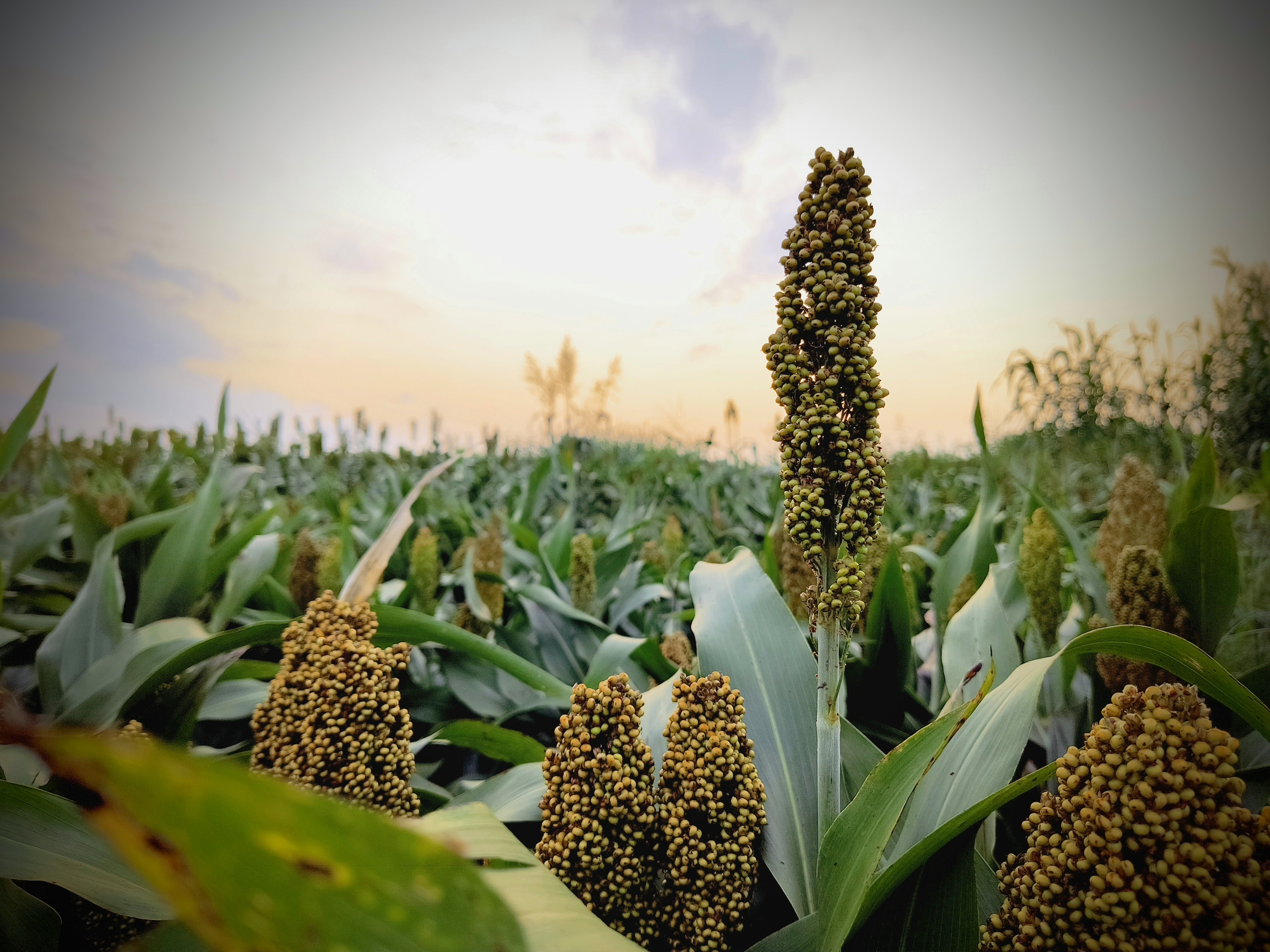
Within its genome, Sorghum bicolor holds keys to drought and flood resilience, biomass production for fuels, and growth in poor soils. In addition to bolstering sorghum fields, understanding this plant eventually offers avenues for translating its strengths into other crops for biofuels and bioproducts.
Historically, work on sorghum has focused on producing high-quality reference genomes. By cataloguing a genome sequence for a line of sorghum, reference genomes have generated insight into drought tolerance, biomass production and more — however, a single reference genome shows only one slice of the adaptation possible for this plant. In other lines around the world, much more genetic diversity exists.
Now, researchers have brought many reference genomes and sequences together at once, producing a pangenome resource for sorghum, recently reported in Nature. “We wanted to build a resource that demonstrates DNA sequence diversity, gene repertoire, and the phenotypic diversity across this plant in one accessible resource,” said John Lovell, a Research Faculty Investigator at the HudsonAlpha Institute for Biotechnology Genome Sequencing Center and a member of the JGI Plant Program. Lovell was a senior author on this work with Nadia Shakoor, a research scientist at Donald Danforth Plant Science Center.
This work is the result of an international collaboration, beginning with the work of the late Todd Mockler, a researcher at Donald Danforth Plant Science Center. Collaborators benefitted from sequencing resources as part of the Community Science Program of the U.S. Department of Energy (DOE) Joint Genome Institute (JGI), a DOE Office of Science User Facility located at Lawrence Berkeley National Laboratory (Berkeley Lab).
A resource for the field(s)
Sorghum has long been one of the JGI’s Flagship Plants, on the short list of plant genomes deemed most important to DOE mission and plant science. The work contributes to the efforts of the DOE Biological and Environmental Research (BER) program to apply systems biology approaches to plants relevant to national energy priorities.
More than a discovery in itself, this pangenome is a tool. It shows genetic variation across sorghum varieties from a much broader view than ever before. With this information, researchers can link genetic variation more closely with gene function and find new ways to implement traits of interest in crops. Ultimately, the pangenome will allow researchers and breeders to more quickly adapt plants for new end uses and conditions.
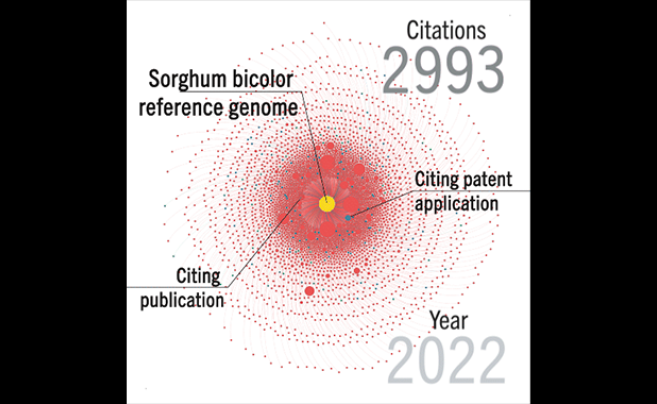
The JGI’s sequencing produced the 33 reference genomes to build this pangenome, including a reassembly of the BTx623 reference genome. This cultivar has been the reference since 2009. In the United States, BTx623 is often used as a parent plant to develop commercial hybrids for grain and bioenergy production. Together with resequencing of 1,984 cultivars and landraces, these data capture the diversity of this crop across geographic regions and growing conditions.
This work was enabled by developments in sequencing and analysis methods within the JGI’s plant program. By producing more genomes of higher quality each year, the JGI provides more insight into plant variation for future analysis and discovery.
“We're building the data sets that are needed to build the algorithms of the future. With more understanding of how these genes function, and how we can manipulate these genes, we’re advancing what we can do with these crop plants that are useful to the DOE mission,” said Jeremy Schmutz, head of the JGI Plant Program and co-director of the HudsonAlpha Genome Sequencing Center.
Surfacing new knowledge with a pangenome
Using this pangenome resource, this team demonstrated ways of understanding what kind of conditions drive genetic change in lines, as well as how structural changes connect to specific traits. They also saw long-studied traits come into clearer view.
In one thread of this work, this team looked at a gene that traces domestication, SHATTERING1. This gene controls whether a plant keeps its seeds attached when picked. Wild plants will ‘shatter’ their seeds off a stem to distribute them, but domesticated lines were selected to hang onto those seeds instead, effectively switching off the shattering trait.
Previous reference genomes seemed to show that turning off the shattering gene resulted from single-base changes in DNA, called single nucleotide polymorphisms. Using the pangenome resource and new analysis methods to zoom in on structural variation, this team was able to see that in fact, it’s a large stretch of DNA — an 8,000 base pair insertion — that drives the switch away from shattering.
“That was one of the most exciting things for me as a computational biologist. We're totally transforming how we think of things that we thought we knew everything about,” said Lovell.
In future work, a pangenome offers many more knowledge transformations — including understanding of traits we know little about.
Researchers from Colorado State University, DIRAD, Clemson University, University of California, Davis, University of Arizona, ICRISAT, DOE Center for Advanced Bioenergy and Bioproducts Innovation, University of Southern California, University of California Berkeley, Salk institute, Ethiopian Institute of Agricultural Research, Texas A&M University, CHIBAS (Haiti) Purdue University, Université de Montpellier (France), Pennsylvania State University and the University of Nebraska were also involved in this work.
Aside from the Department of Energy, the Gates Foundation, the Advanced Research Projects Agency-Energy (ARPA-E) and the United States Agency for International Development (USAID) also supported the work.
Publication: Morris, G.P., Harder, A.M., Healey, A.L. et al. A sorghum pangenome reference improves global crop trait discovery. Nature (2026). doi:10.1038/s41586-026-10229-9




More Details
Plant
BER Support Science
Community Science Program
Bioenergy Research Centers
Morris, G. P. et al. (2026) A sorghum pangenome reference improves global crop trait discovery. Nature. 10.1038/s41586-026-10229-9
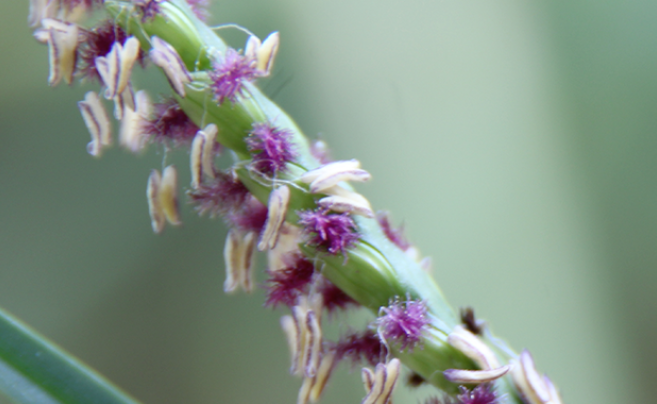
Plant Program
Our Plant Program focuses on biofuel feedstock species and plant-microbe interactions, advancing efforts to create renewable energy sources and bolster agricultural resilience.


Community Science Program
The CSP provides the scientific community at large with access to high-throughput sequencing and other resources at the JGI for projects of relevance to Department of Energy missions.