Complete Genome of Oil-Rich Alga Reveals Ideal Platform for Bioengineering
Streamlined genome with precise gene targeting transforms oil-producing alga into a powerful platform for developing bio-based industrial products.
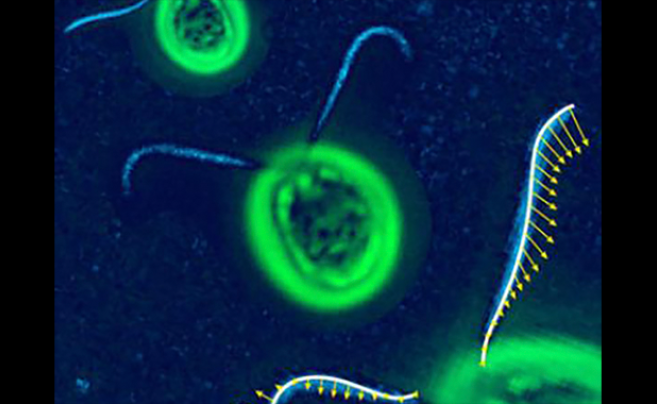
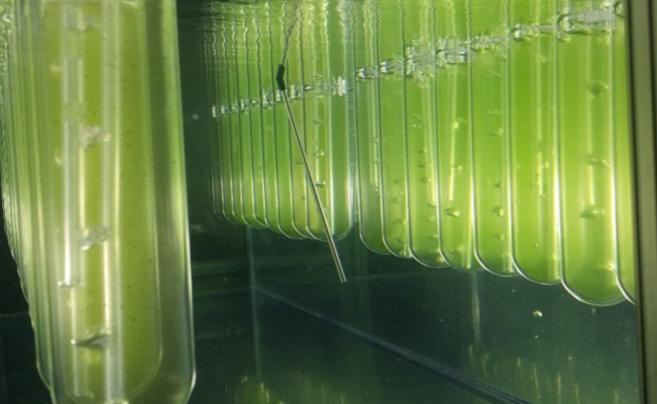
The image shows co-occurrence of fluorescence from chlorophyll and green fluorescent protein targeted to the Auxenochlorella chloroplast. (Image courtesy of Maria Clara Avendaño-Monsalve, UC Berkeley)
The Science
Scientists have fully decoded the genome of an oil-producing green alga, and demonstrated precise gene targeting in the genome in the November 2025 issue of The Plant Cell.Auxenochlorella is an allodiploid hybrid of two species, similar to a mule, but that is still able to reproduce asexually through mitosis. The alga naturally produces high amounts of oil and can grow with or without light. The relatively small size of its genome also simplifies metabolic modeling and pathway optimization for enhanced lipid production. Also notable, researchers found it is missing 33 genes thought essential for photosynthesis, yet still thrives.
The Impact
This discovery creates a powerful platform for producing specialty oils, chemical feedstocks and industrial precursors — as well as to better enable the mining of critical minerals and materials. The precise gene-targeting capability for Auxenochlorella means engineers can produce new bioproducts in a more predictable and reliable manner. Because of the ease with which the alga can be genetically engineered, it has the potential to be imbued with effective capabilities needed for biorecovery of critical minerals. Due to its ability to photosynthesize, it can function as a self-sufficient biotechnology. Overall, this work supports the mission of the Department of Energy (DOE) Biological and Environmental Research (BER) program to advance a fundamental understanding of genome biology, and develop genome-scale engineering technologies to control plants and microbes for bioproducts and biomaterial manufacturing.
Summary
Auxenochlorella UTEX 250-A provides an unprecedented foundation for metabolic engineering in oleaginous algae. By creating a telomere-to-telomere nuclear genome assembly, researchers offer a gapless end-to-end sequence of complete chromosomes.
Auxenochlorella solves a major challenge in algal engineering by allowing for dramatically more precise gene-targeting. While genetic modifications usually insert randomly in other algae, this organism lets scientists place new genes precisely where intended due to its capacity for homologous recombination. Finding that "essential" genes can be deleted opens new engineering possibilities. The rapid evolution observed suggests directed evolution could quickly generate improved strains. Scientists have already used this alga to understand how genes with unusual structures work in green algae.
The genome is remarkably simple with only 7,500 genes, compared to 17,000 in the model alga Chlamydomonas. The genome is also compact at 22 megabases versus 120 MB in Chlamydomonas. With fewer redundant pathways and clearer gene-to-function relationships than other algae, Auxenochlorella’s reduced genomic complexity can accelerate the design-build-test cycle for metabolic engineering.
The discovery that Auxenochlorella thrives despite lacking 33 conserved photosynthesis genes suggests remarkable metabolic flexibility for engineering. The organism's ability to switch between autotrophic and heterotrophic growth enables production strategies that optimize either solar-driven or fermentation-based oil synthesis. Since the genome evolves measurably in just decades of laboratory culture, researchers could use controlled evolution experiments to rapidly generate strains optimized for industrial oil production.
The organism uses specific chemical tags on DNA to control which genes are active. Researchers also identified transfer RNA genes with unusual structures that could be useful for protein production and other biotech applications. Engineers could manipulate these natural systems to tune gene activity without permanently altering the genome. Auxenochlorella could be an ideal chassis for producing not just high-value lipids, but also designer chemicals and bio-based materials essential for national security, supply-chain resilience and diversifying industrial feedstock sources.
Contacts
BER Contact Ramana Madupu, Ph.D Program Manager Biological Systems Sciences Division Biological and Environmental Research Program Office of Science Department of Energy [email protected]
PI Contact Sabeeha Merchant University of California, Berkeley [email protected]
This work was supported by the Department of Energy (DOE) Office of Science, Biological and Environmental Research program under award no. DE-SC0023027 (to SSM and JLM) with support from the Gordon and Betty Moore Foundation (to SSM) for the work on A. symbiontica (9203). RJC was supported for his work on Auxenochlorella genome sequencing and assembly in Berkeley, in part, through the Laboratory Directed Research and Development Program of Lawrence Berkeley National Laboratory (to SSM) under U.S. Department of Energy Contract No. DE-AC02-05CH11231. MAD was supported, in part, by the NIH T32 Genetics Dissection of Cells and Organisms Grant (1T32GM132022-01) and the Newton Graduate Fellowship in Synthetic Biology (QB3-Berkeley). DJC was supported in part by the NIH T32 Molecular Basis of Cell Function Training Grant (5T32GM007232-44) and the University of California, Berkeley, Chancellor’s Fellowship. Work at the Molecular Foundry was supported by the Office of Science, Office of Basic Energy Sciences, of the U.S. Department of Energy under Contract No. DE-AC02-05CH11231 (CB-H). Work at the U.S. Department of Energy Joint Genome Institute (https://ror.org/04xm1d337), a DOE Office of Science User Facility, is supported by the Office of Science of the U.S. Department of Energy operated under Contract No. DE-AC02-05CH11231 (CLB-H).
Craig, R. J. et al. (2025) Targeted genetic manipulation and yeast-like evolutionary genomics in the green alga Auxenochlorella. The Plant Cell. 10.1093/plcell/koaf259
The Fungal & Algal Program explores the vast diversity of fungi and algae to unlock their potential for bioenergy, environmental sustainability, and bioproducts.
Learn more about calls available through our Community Science Program, as well as collaborative calls with our partner facilities and other opportunities.