Contacts
PI Contact
Carolin Frank
Associate Professor, Life and Environmental Sciences
University of California, Merced
[email protected]


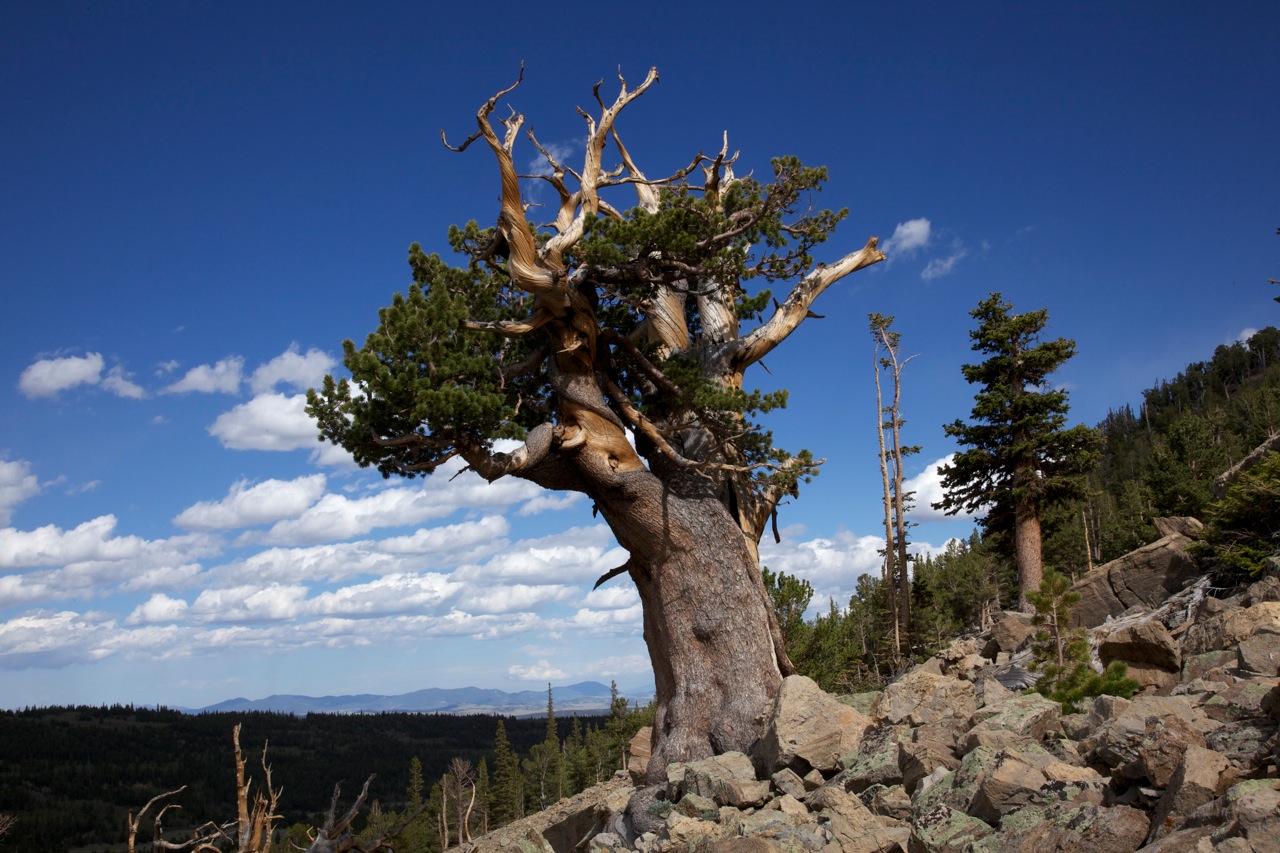
In a recent Microbiome paper, scientists focused on the conifer needle microbiome. The phyllosphere, which is known as the aerial surface of plants, is a comparatively understudied area of forest ecosystems as past studies have mainly focused on root-associated microbiomes. Scientists conducted a shotgun metagenomic survey on three types of conifers–limber pine, Douglas fir and Engelmann spruce–to learn more about conifer needle microbiomes. The survey showed what these microbes are equipped to do on the leaf surface. More specifically, they found that microbial community composition and functional potential varied across tree species and sites, reflecting ecological patterns shaped by both local conditions and the movement of microbes through forest canopies.
This work, enabled in part by the U.S. Department of Energy (DOE) Joint Genome Institute (JGI), a DOE Office of Science User Facility located at Lawrence Berkeley National Laboratory (Berkeley Lab), is of importance to the Department of Energy (DOE) Office of Science’s Biological and Environmental Research program because of its relevance to understanding the assembly, function, and the behavior of microbiomes to advance their utility across the bioeconomy. The study shows that microbes have the capacity to metabolize the same chemicals conifers use for defending themselves, which has important implications for plant health. It also provides further insight into the ecology and functional potential of the phyllosphere, extending beyond the leaf surface to broader forest and ecosystem processes revealed through their diverse genomic capabilities.
In a project supported by the JGI Community Science Program, University of California (UC) Merced scientists conducted a shotgun metagenomic survey of conifer needle microbiomes across six sites spanning a 1000km section of the Rocky Mountains. This represents the first study of this nature.
The phyllosphere is a major habitat for plant-associated microbes at the interface between land and the atmosphere. Microbes living there can interact with chemical defenses of plants and influence nutrient turnover over the course of a leaf’s life. Additionally, the phyllosphere microbes can degrade and transform plant-emitted volatile organic compounds (VOCs), potentially influencing local air chemistry and the formation of atmospheric aerosols. Understanding the composition and functional potential of these microbes is crucial to understanding their involvement in stress tolerance and plant health. Microbes that are on leaf surfaces contribute to key plant and ecosystem processes, including resilience to stress, decomposition, and interactions between forests and the atmosphere.
The team learned that some bacterial families carry genes for degrading monoterpenes such as α-pinene, as well as genes for breaking down complex plant polymers. These capabilities suggest these microbes can use conifer-derived chemical defense chemicals and surface polymers as metabolic substrates. Microbial community composition varied across both sites and host tree species, with geographic site exerting the stronger influence. Although no single environmental variable explained these differences, differences among sites, including elevation, temperature, and precipitation, likely contributed. Additionally, some bacterial groups were quite specific to certain hosts, such as the Hymenobacter on Engelmann spruce needles. Together, these patterns indicate that host chemistry and site conditions shape both the taxonomic makeup and functional potential of needle-surface communities.
Part of the work was done through a summer project in the JGI-UC Merced Internship Program. In 2023, Shayna Bennett, a UC Merced graduate student in Carolin Frank’s lab, worked on an aspect of the paper with her JGI mentor, Robert Bowers. She contributed to the analysis of mobile genetic elements across all of the metagenomes. Learn more about her time at the JGI here.
Bennett is applying the same experiment to a new environment. She is currently working on her thesis to characterize the microbiome phyllosphere of black oak leaves throughout Northern California.
Carolin Frank
Associate Professor, Life and Environmental Sciences
University of California, Merced
[email protected]