DOE Joint Genome Institute

  • COVID-19
  • About Us
  • Contact Us
  • Our Science
    • DOE Mission Areas
    • Science Programs
    • Science Highlights
    • Scientists
    A photo of Great Boiling Spring in the forefront with mountains in the background.
    New Research Finds Flagella in the Terrestrial Roots of Marine Bacteria
    Scientists have discovered flagella in an unexpected place: hot spring-dwelling bacteria. Research shows that flagella were lost in other forms of Chloroflexota that adapted to marine environments hundreds of millions of years ago

    More

    Sphagnum fallax (Image courtesy of Jonathan Shaw, Duke University)
    Sequencing Sphagnum Leads to Discovery of Sex Chromosomes
    Boggy peatlands are primarily made up of sphagnum mosses. New research illuminates the significant role sex plays in how the moss grows, stores carbon and responds to stress.

    More

    A vertical tree stump outdoors with about a dozen shiitake mushrooms sprouting from its surface.
    Tracing the Evolution of Shiitake Mushrooms
    Understanding Lentinula genomes and their evolution could provide strategies for converting plant waste into sugars for biofuel production. Additionally, these fungi play a role in the global carbon cycle.

    More

  • Our Projects
    • Search JGI Projects
    • DOE Metrics/Statistics
    • Approved User Proposals
    • Legacy Projects
    A panoramic view of a lake reflecting a granite mountain.
    Genome Insider: Methane Makers in Yosemite’s Lakes
    Meet researchers who sampled the microbial communities living in the mountaintop lakes of the Sierra Nevada mountains to see how climate change affects freshwater ecosystems, and how those ecosystems work.

    Listen

    A light green shrub with spiny leaves, up close.
    Genome Insider: A Shrubbier Version of Rubber
    Hear from the consortium working on understanding the guayule plant's genome, which could lead to an improved natural rubber plant.

    Listen

    An underwater photo with a blue backdrop and a mineral formation erupting black, mineral-rich fluid.
    Shedding Light on Diversity in the Deep Sea
    Hydrothermal vents are too deep in the sea to get any sunlight, and yet they still support a unique array of microorganisms adapted to living in extreme conditions.Researchers studied microbial communities at these vents across five oceanic regions.

    More

  • Data & Tools
    • IMG
    • Data Portal
    • MycoCosm
    • PhycoCosm
    • Phytozome
    • GOLD
    Data yielded from RIViT-seq increased the number of sigma factor-gene pairs confirmed in Streptomyces coelicolor from 209 to 399. Here, grey arrows denote previously known regulation and red arrows are regulation identified by RIViT-seq; orange nodes mark sigma factors while gray nodes mark other genes. (Otani, H., Mouncey, N.J. Nat Commun 13, 3502 (2022). https://doi.org/10.1038/s41467-022-31191-w)
    Streamlining Regulon Identification in Bacteria
    Regulons are a group of genes that can be turned on or off by the same regulatory protein. RIViT-seq technology could speed up associating transcription factors with their target genes.

    More

    Illustration of a magnifying glass identifying viruses and plasmids.
    geNomad: Rapidly identifying mobile genetic elements
    geNomad builds on two standard techniques for identifying viruses and plasmids. It can identify millions of new viruses and plasmids quickly, even in massive datasets.

    More

    LISTEN: Natural Prodcast on the SMC
    Check out the JGI Secondary Metabolism Collaboratory (SMC), a new data portal for natural product biosynthetic gene clusters and meet Prodcast cohost Jackie Winter.

    More

  • User Programs
    • Calls for Proposals
    • Special Initiatives & Programs
    • Product Offerings
    • User Support
    • Policies
    • Submit a Proposal
    A series of headshots: From left to right: [above] Olivia Ahern, Adriana Corales, Hugh Cross, Megan DeMarche, Joanne Emerson, Matthew Hudson, Megan Keller and Julia Kelliher; [below] Vassili Kouvelis, Seppe Kuehn, Tesfaye Mengiste, Egbert Schwartz, Hannah Schulman, Bram Stone and Jana Voriskova
    2024 awardees for JGI Community Science Program annual call
    Learn about the 15 projects selected through the JGI's FY2024 Community Science Program Annual Call - and the investigators behind them.

    More

    Collage capturing a diverse set of bacteria and functions that can be better understood using DAP-seq. (Eduardo de Ugarte/Berkeley Lab)
    Enlarging Windows into Understanding Gene Functions
    Two approaches build up DAP-seq, which allows researchers to identify all the sites where transcription factors bind quickly and efficiently in the genome by adding tagged transcription factors to a genomic DNA library.

    More

    Green plant matter grows from the top, with the area just beneath the surface also visible as soil, root systems and a fuzzy white substance surrounding them.
    Supercharging SIP in the Fungal Hyphosphere
    Applying high-throughput stable isotope probing to the study of a particular fungi, researchers identified novel interactions between bacteria and the fungi.

    More

  • News & Publications
    • News
    • Blog
    • Podcasts
    • Webinars
    • Publications
    • Newsletter
    • Logos and Templates
    • Photos
    A Decade On: The JGI-UC Merced Genomics Internship Program
    What started with 2 interns in the summer of 2014 has grown to 75 student alumni. Mentors, students and others gathered to reflect on the benefits of this partnership.

    More

    A tiled collage of square photos of different plants - soybeans, and sorghum, for example.
    A Collaboration to Improve Plant Genome Annotations Across Species
    The JGI Plant Gene Atlas is an updateable transcriptome resource spanning diverse plant species. The project spans 15 years and involves more than 17 research groups.

    More

    Pictured is a micrograph of Neocallimastix californiae.
    Busting the Unbreakable Lignin
    Turns out anaerobic fungi are actually capable of naturally modifying lignin. A study with the first real irrefutable proof that lignin can be deconstructed without oxygen.

    More

About Us

  • People
  • Location
  • History
  • Partners
  • Committees
  • Ops Expenses
  • Progress Report
  • Diversity
  • Workforce Development

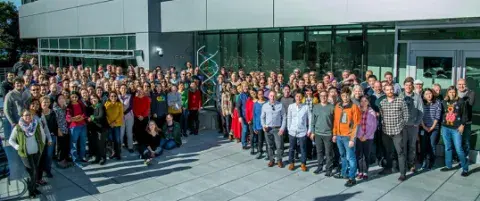
The U.S. Department of Energy (DOE) Joint Genome Institute (JGI) is a DOE Office of Science User Facility at Lawrence Berkeley National Laboratory (Berkeley Lab) and part of the Biosciences Area.

Our vision: To lead genomic innovation for a sustainable bioeconomy.

Our mission: As a U.S. Department of Energy Office of Science user facility, we provide advanced genomic capabilities, large-scale data, and professional expertise to support the global research community in studies of complex biological and environmental systems. We optimize our service to the community through responsibly managing our people and resources.

  • 2024-2029 Strategic Plan: Fast Download PDF | Print Quality PDF
  • 2023 Progress Report
  • 2024 Genome Science Trifold
  • 2018-2023 Strategic Plan Implementation Report
  • JGI Scientist Code of Conduct

Supported by the DOE Office of Science, the JGI unites the expertise at Berkeley Lab, Lawrence Livermore National Laboratory, and the HudsonAlpha Institute for Biotechnology. Located in the Integrative Genomics Building in the heart of the Berkeley Lab campus, atop the hills above Berkeley, California, the JGI is operated by the University of California for the U.S. Department of Energy. The JGI provides integrated high-throughput sequencing, DNA design and synthesis, metabolomics and computational analysis that enable systems-based scientific approaches to these challenges.

Diversity, Equity & Inclusion

Fostering a diverse workforce and a culture of inclusion for scientific excellence and groundbreaking innovations.

Learn More

FY2023 Spending Profile

A pie chart of how we put our funding to use.

Learn More

Location

Information about the location and how to get there.

Learn More

History

The history of how JGI came to be and where we are today.

Learn More

Workforce Development

Our educational outreach goal is to inspire more students to enter the STEM workforce.

Learn More

User Advisory Committees

A list of the JGI advisory committees.

Learn More

Annual Progress Report

The institute’s annual report of its activities.

Learn More

Partners

Our partner institutions LBNL, LLNL and HudsonAlpha.

Learn More

  • Careers
  • Contact Us
  • Events
  • User Meeting
  • MGM Workshops
  • Internal
  • Disclaimer
  • Credits
  • Policies
  • Emergency Info
  • Accessibility / Section 508 Statement
  • Flickr
  • LinkedIn
  • Twitter
  • YouTube
Lawrence Berkeley National Lab Biosciences Area
A project of the US Department of Energy, Office of Science

JGI is a DOE Office of Science User Facility managed by Lawrence Berkeley National Laboratory

© 1997-2024 The Regents of the University of California