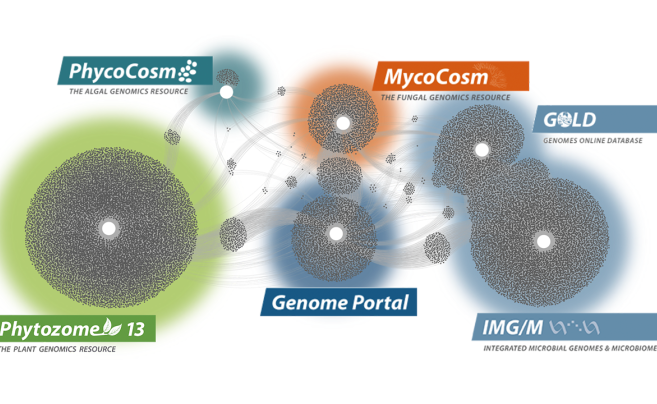
When the JGI Data Portal (https://data.jgi.doe.gov/) launched last year, it was only accessible through the plant portal Phytozome.
With a common set of “baseline metadata,” JGI users can more easily access public data sets. (Steve Wilson)
Now the portal offers a way for users to more easily access public data sets through a common set of metadata.
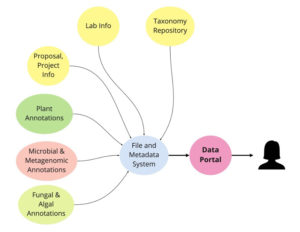
For Steve Wilson, JGI’s Systems Engineering group lead, the Data Portal reflects a structural shift in data access. Users were previously limited to accessing data sets within groups, such as plants (via Phytozome) or fungi (MycoCosm). “We have made a concerted effort to create a common set of ‘baseline metadata’ across the files that are submitted by each scientific program,” he said. “If each kingdom submits the same category of data (key) for their files as a baseline, we can allow a user to collect all of the ‘protein FASTA files’ more easily.” He also elaborated on the following topics.
Q(uestion): What is the Data Portal’s scope? A(nswer): The JGI Data Portal currently allows users to find files by searching file metadata (info describing the files)
We are currently limited to:
Public data: datasets associated with completed projects that are eligible for public release, have completed their embargos, and numerous other requirements.
Data that passes through a kingdom portal (assemblies + annotations)
For IMG & Mycocosm: Data that is associated with an ITS project ID (AP or SP)
Q: What JGI Data Policy considerations do users accessing need to be mindful of? A: The JGI Data Portal currently only presents public data (both restricted and unrestricted).
The Data Portal presents the users with the standard JGI Data Release Policy information when they request a download. When we have a calculation for automatically determining which datasets are unrestricted and which are not, we will be able to display that on JDP and allow users to filter on that parameter.
The current Data Restriction Policy requires that users know about the FY Funding Year, and the publication status in addition to the public/private status.
Q: Does Data Portal work well with KBase and NMDC? A: We have reached out to KBase regarding use of our search API. They have expressed an interest in using this to find files based on file metadata criteria.
Wilson said that the Data Portal and Genome Portal will continue to run in parallel for now. Eventually, he added, the Genome Portal will be retired once the same features are available on Data Portal.
The U.S. Department of Energy Joint Genome Institute, a DOE Office of Science User Facility located at Lawrence Berkeley National Laboratory, is committed to advancing genomics in support of DOE missions related to clean energy generation and environmental characterization and cleanup. The JGI provides integrated high-throughput sequencing and computational analysis that enable systems-based scientific approaches to these challenges.
DOE’s Office of Science is the largest supporter of basic research in the physical sciences in the United States, and is working to address some of the most pressing challenges of our time. For more information, please visit energy.gov/science/office-science.
Our data platforms are a key resource for the broader scientific community and require constant developments to meet the ever-changing demands of our users.
Prospective users are encouraged to reach out to program heads with questions about the JGI’s science and opportunities to partner with the JGI on their research.
Learn more about calls available through our Community Science Program, as well as collaborative calls with our partner facilities and other opportunities.