A Pinch of Salt Activates Silent Gene Clusters in Streptomyces
This single environmental trigger highlights efficiency for users requiring multiple omics methods to examine microbial chemical production.
The Science
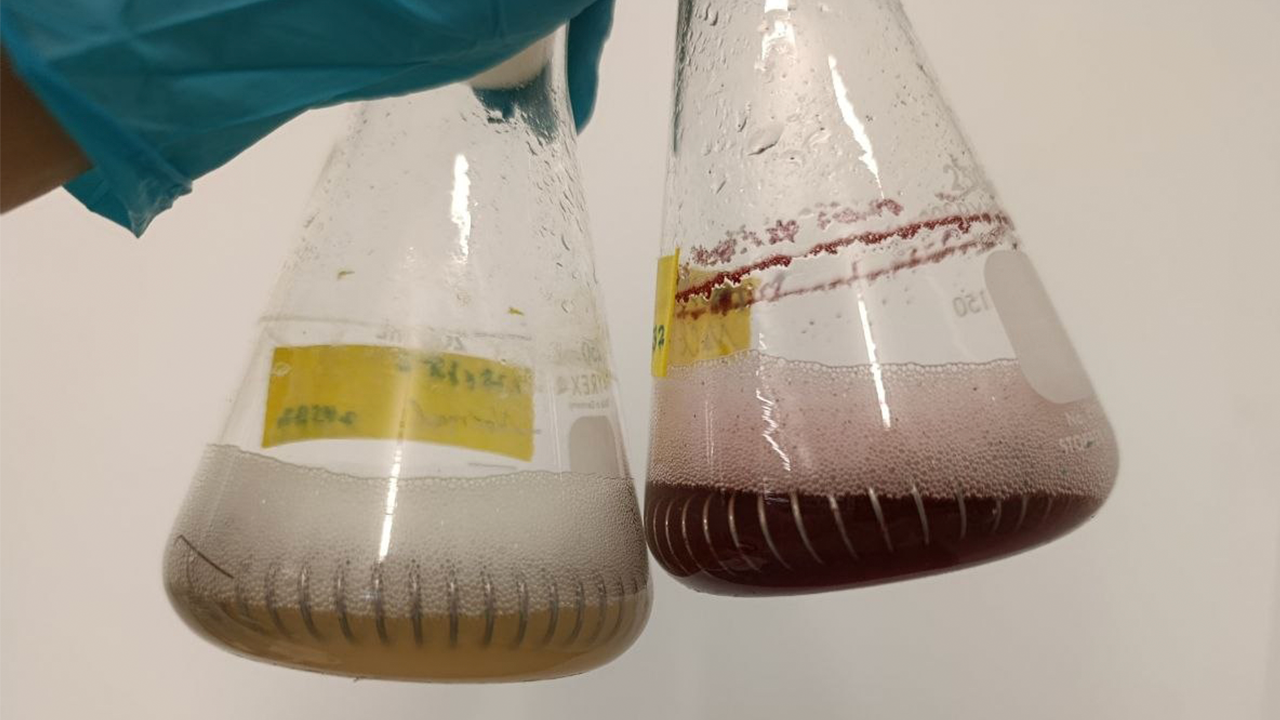
Streptomyces coelicolor culture starts out yellow (left) but turns red with salt supplementation (right). The salt induces the production of various secondary metabolites, including red-coloured compounds. [Image: Kateryna Kukil]
Soil bacteria in the genus Streptomyces are nature's chemical factories. They hold genetic blueprints for dozens of complex compounds, but stay largely dormant under standard conditions. As described in a recent issue of mSystems, scientists found that adding salt to the growth medium caused Streptomyces coelicolor to activate multiple chemical production pathways. By tracking gene activity and chemical output over time, the team mapped how the bacterium redirects its energy, building blocks and regulatory machinery toward chemical production — a coordinated response that had never been mapped in this detail before.
The Impact
By revealing how a single stress signal rewires a bacterium's entire metabolism for chemical production, the study provides a blueprint that engineers can use to design more efficient microbial factories. Identifying specific genes, regulatory elements and metabolic pathways that enable that shift provides engineers concrete targets for optimization. Many of the metabolic switches identified are shared across hundreds of related species, meaning these insights are potentially broadly applicable. The findings hold the potential to accelerate development of bio-based manufacturing processes for producing industrial chemicals, specialty materials and high-value bioproducts. This study offers a template — integrative analysis of multiple omics data from various environments — that JGI users can leverage to create a more complete picture of how microbes control useful chemistry in other organisms.
Summary
Most Streptomyces species can produce roughly 30 secondary metabolites — chemical compounds not required for basic survival but often useful as bioactive molecules. The instructions for building each compound are encoded in a dedicated set of genes called a biosynthetic gene cluster. However, most of these gene clusters remain silent under standard laboratory conditions.
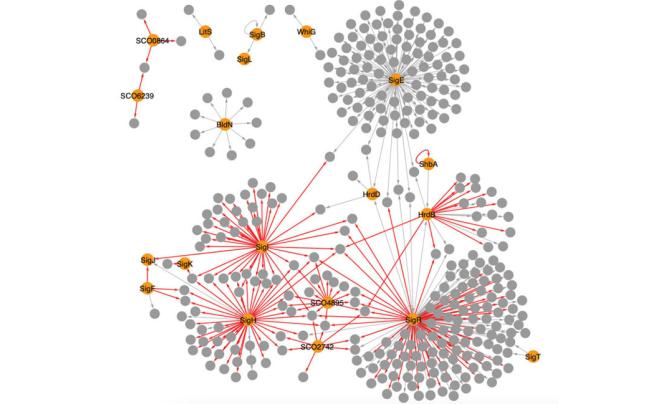
Researchers with the Department of Energy (DOE) Joint Genome Institute (JGI), a DOE Office of Science user facility located at Berkeley Lab, screened dozens of growth conditions and found that adding a small amount of common salt to the Streptomyces coelicolor growth medium most strongly activated these clusters. This triggered the bacterium to produce multiple bioactive compounds at once, including several with known antimicrobial and industrial relevance, along with many previously uncharacterized molecules. To understand how salt triggers this metabolic shift, the team combined RNA sequencing across multiple time points with Cappable-seq, a technique that precisely maps where transcription begins on the genome.
This revealed a sweeping cellular response: The bacterium absorbs potassium ions to balance the added salt and activates compatible solute pathways to counteract osmotic stress. Unexpectedly, the increased salinity caused the cell to consume phosphate from its environment more quickly than usual. In addition, the combination of the two stressors prompted a drastic metabolic shift. The net effect is coordinated upregulation of energy production, biosynthetic precursor supply, enzyme activation machinery, and the biosynthetic gene clusters themselves.
The team also identified previously unknown promoter sequences within these gene clusters, offering new regulatory targets for engineering efforts. Importantly, several of the activated pathways are conserved across hundreds of Streptomyces species, pointing toward shared mechanisms that could be exploited for bio-based manufacturing.
This study demonstrates the power of combining multiple omics methods to decode how microbes control chemical production. These efforts support the DOE’s Biological and Environmental Research program’s efforts in advancing genome-based biotechnology. Researchers studying Streptomyces species or related microbes can work with the JGI to apply the same integrated approach to unlock useful chemistry in their organisms of interest — accelerating discovery of bio-based chemicals and materials that strengthen domestic supply chains and industrial competitiveness.
Contacts
BER Contact Ramana Madupu, Ph.D Program Manager Biological Systems Sciences Division Biological and Environmental Research Program Office of Science Department of Energy [email protected]
JGI Contact Hiroshi Otani Research Scientist Secondary Metabolites Program [email protected]
This work conducted by the U.S. Department of Energy Joint Genome Institute (https://ror.org/04xm1d337), a DOE Office of Science User Facility, is supported by the Office of Science of the U.S. Department of Energy operated under Contract No. DE-AC02-05CH11231.
Secondary metabolites provide critical advantages to the organisms producing them, and are often involved in defense, nutrient acquisition and communication.
Learn more about calls available through our Community Science Program, as well as collaborative calls with our partner facilities and other opportunities.